
Compare bulk DIY packs with the parts you will use
Choose a mechanical-component pack size using landed cost per needed usable unit, rather than the lowest advertised price per piece.
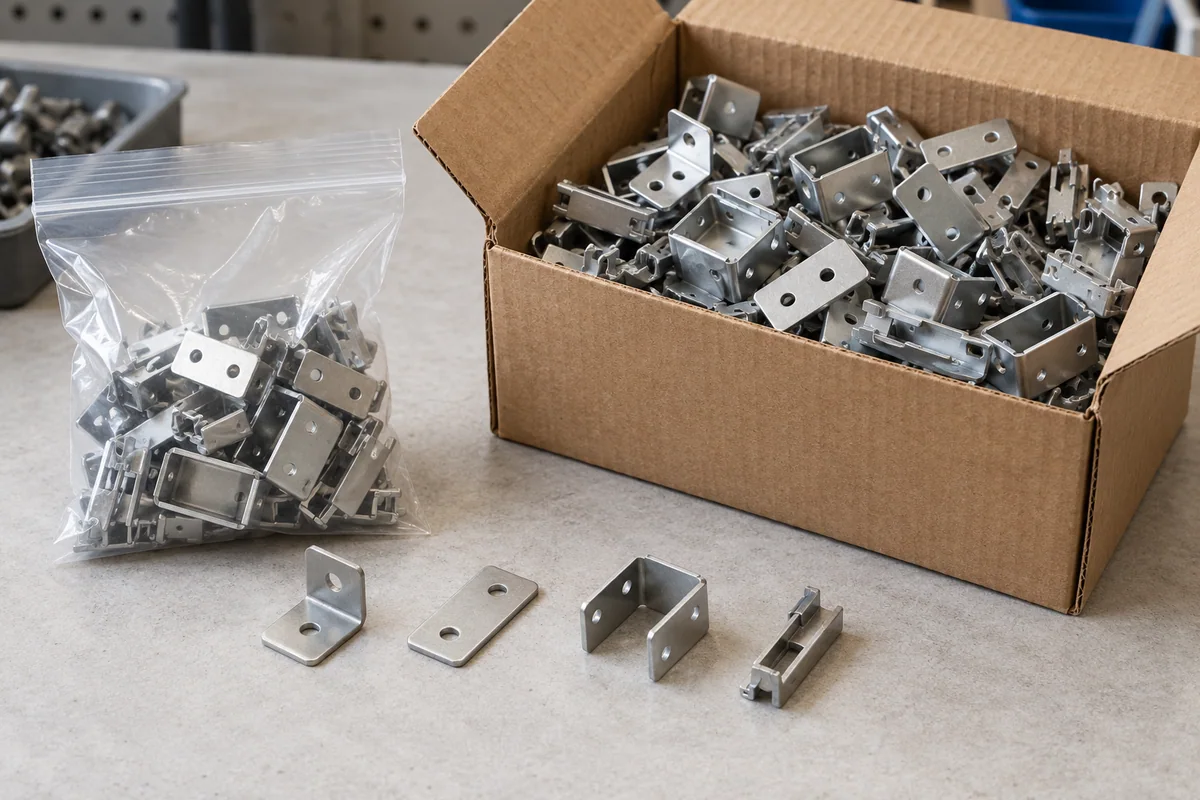
A large component pack is cheaper only if its total landed cost makes sense for the parts you can actually use. Compare pack multiples, specification fit, realistic project demand and transport costs before treating a low per-piece price as a saving. Unused parts are inventory, not automatically value recovered.
This guide covers ordinary, non-energized mechanical DIY components such as non-safety-critical craft spacers, organizer hardware and decorative brackets. It does not cover batteries, electrical assemblies, load-bearing safety applications or vehicle components. Those require application-specific engineering and compliance review beyond this cost worksheet.
Convert the project into a usable requirement
List the exact component and revision, dimensions, material, finish and any mating-part requirements. Identify which attributes are essential and which are flexible. A mixed-size assortment is not equivalent to a pack containing only the size you need.
For each project, calculate quantity per build multiplied by the number of planned builds. Add a spare allowance only when you have a reason for it, such as an established loss rate or a specific maintenance need. Label uncertain future projects separately rather than counting them as guaranteed demand.
Check how the listing defines quantity. “100 pieces” might describe individual items rather than 100 complete sets. Ask whether matching fasteners, washers or other required pieces are included. Clarify whether colors and sizes are selectable or supplied in a fixed mix. A low price for the wrong pack composition cannot be corrected by cheaper shipping.
Before scaling the purchase, verify fit through an appropriate sample or documented dimensional check where practical. A supplier’s listing is an input to verification, not proof that every unit will meet your requirement. Do not invent a rejection allowance to make the mathematics look precise; use a labeled sensitivity case when reliable evidence is unavailable.
Translate demand into purchasable packs
For a single-size pack, packs required equal demand divided by units per pack, rounded up to a whole pack. Purchased quantity equals packs required multiplied by pack size. For assortments, calculate the relevant size’s quantity separately.
If you need 75 matching spacers and a 100-piece assortment contains only 20 of that size, one assortment does not meet the requirement. You would need four identical assortments to obtain 80 matching spacers, assuming the listed composition is accurate. The other 320 pieces may be useful later, but that future use should not be silently credited to the current project.
Ask the supplier for the actual selectable pack sizes and any minimum-order requirement. This guide assumes no standard minimum. A smaller pack at a higher unit price can still reduce total project spending, inspection effort and storage.
Compare landed totals on the same basis
Build a cost for the actual pack quantity: product, origin services, transport, applicable destination charges and final delivery. Include duties and non-recoverable taxes where established; keep tax treatment explicit rather than treating all taxes alike.
Do not estimate freight from the component’s net weight alone. DHL’s chargeable-weight guidance explains why mode, volume and packaging matter. Obtain final packed dimensions and gross weight for each option. A pack-size increase may change carton count or handling even when the loose components look small.
For EU imports, the European Commission identifies tariff, customs value and origin as duty inputs. That does not establish a duty rate for “DIY components.” Have the actual destination classification and applicable measures checked rather than adopting a supplier’s generic description as a completed tax calculation.
Use two denominators: accepted units received, and usable units needed within your defined planning period. The first measures purchase yield; the second reveals overbuying for the present purpose.
Hypothetical example: a 75-part project
The following USD costs and pack choices are invented arithmetic, not observed offers. Assume identical, suitable, non-safety-critical mechanical parts; all delivered units pass acceptance; delivery timing meets the project need; and the stated totals include all attributable non-recoverable landing charges. Exclude financing, storage and uncertain resale proceeds.
Option A is one 100-part pack costing $40, plus $50 attributable freight and other landing charges. Total cost is $90. Cost per accepted part is $90 ÷ 100 = $0.90. Cost per part needed for the 75-part project is $90 ÷ 75 = $1.20, with 25 parts left over.
Option B is one 500-part pack costing $150, plus $90 attributable landing charges. Total cost is $240. Cost per accepted part is $240 ÷ 500 = $0.48. For the same 75-part project, however, it is $240 ÷ 75 = $3.20, with 425 parts left over.
Option C is buying exactly 75 equivalent parts locally for $1.60 each, with no additional delivery cost under this hypothetical offer. Total cost is $120. Option A saves $30 against C; Option B spends $120 more than C despite its lowest per-received-part figure.
That does not make B inherently bad. Against the hypothetical $1.60 local unit price, B’s $240 total equals the cost of 150 local parts. If at least 150 suitable parts will genuinely be used during the chosen period, B reaches parity with that local alternative; above 150 it becomes cheaper on the stated direct-cost assumptions. This is not a break-even result against repeated small imported packs, whose freight and ordering pattern would need their own calculation.
Stress-test the tempting large pack
Ask what happens if the project changes specification, only some sizes fit or delivery is later than needed. A useful sensitivity test keeps the price fixed and reduces usable demand. If only 50 parts from Option A are needed, $90 ÷ 50 = $1.80 per needed part. The local option for those 50 parts would be $80 under the same hypothetical unit price, making the import $10 more expensive.
Do not count future resale at full purchase value unless you have credible demand and include selling costs. Similarly, storage space and cash tied up in surplus can matter even when you choose not to assign them a dollar value. Record those constraints explicitly.
Before asking for a sourcing quote, prepare one short requirement sheet: exact specification, required usable quantity, acceptable pack composition, delivery need and packed-data request. Compare at least one smaller-pack or exact-quantity alternative. The best purchase is the one that meets the real project economically, not the one with the most pieces in the carton.
Frequently asked questions
Is the largest pack always the best value?
No. Compare total landed spending against realistic usable demand. The lowest cost per received piece may require buying far more than the project needs.
How should I value leftover components?
Keep them as surplus unless you have a credible use within the planning period. Show future use or resale as a separate scenario with relevant costs and uncertainty.
How do I compare an assortment with a single-size pack?
Count the pieces that meet the actual specification. Round up the number of assortments needed for that size, then include the full cost of all purchased assortments.
Does this guide cover DIY batteries or electrical assemblies?
No. It is limited to ordinary non-energized, non-safety-critical mechanical components. Energized and safety-relevant projects need qualified, application-specific review.
Sources
Discuss a sourcing request related to this article.Compare bulk DIY packs with the parts you will use