
Place Approved Instructions Where the Kit Recipient Can Find Them
Assign approved instruction files to each kit configuration and reserved insert position so recipients can find them without disturbing required information.
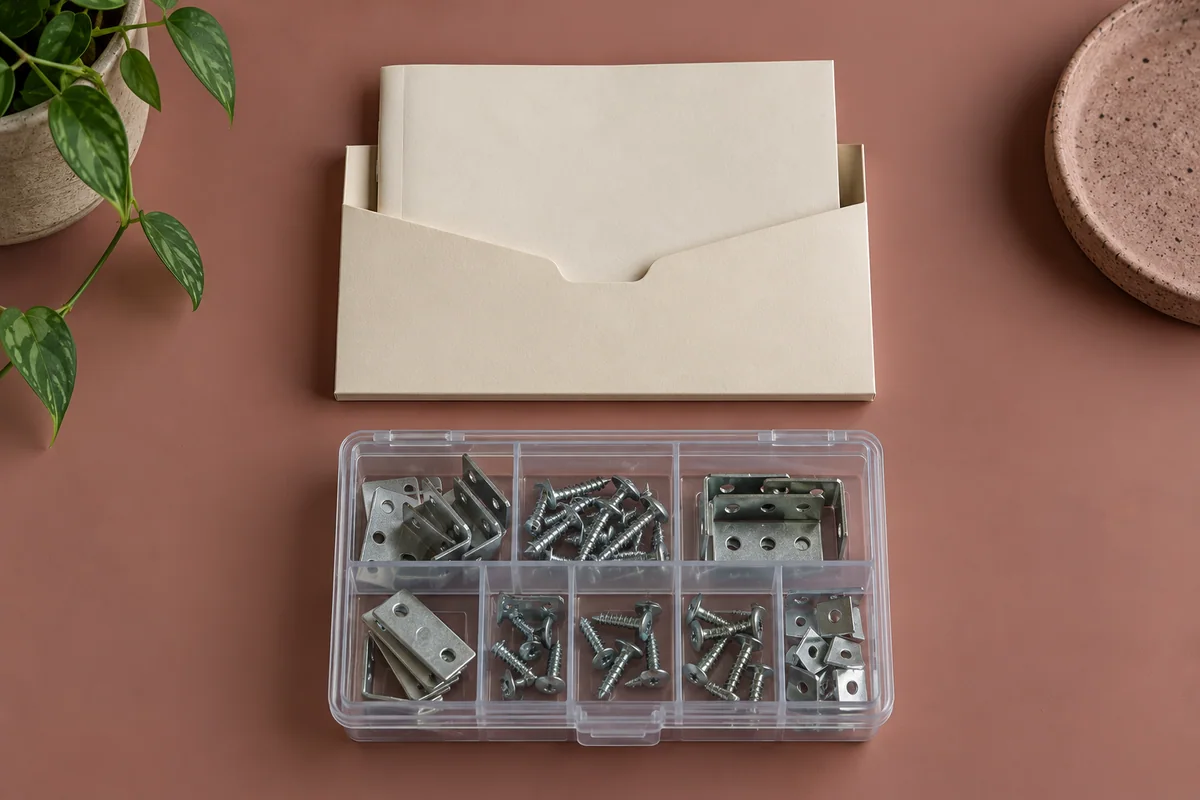
Assign every approved instruction insert to a specific kit configuration and a defined place in the pack. “Manual included” does not tell the packer which approved language version belongs in each kit, which face should be visible at opening, or whether the recipient must move parts to find it. An insert assignment and placement map closes those practical gaps.
This method starts after the content and physical format have been approved. No actual kit instructions, approved artwork or packing layout were supplied. It does not write assembly directions, validate translations, decide required regulatory wording or establish that a digital link can replace a printed document.
Use the approved artifact as the input
Record each insert’s controlled identifier, revision and approved language coverage. Identify the exact kit configurations it applies to. Keep a main booklet and a variant supplement as separate artifacts when the approved content package treats them separately.
Use the physical format already approved: page or panel extent, finished size and fold or binding reference where specified. The placement exercise should not quietly change those features to make an inconvenient pocket work. If the approved artifact cannot be accommodated, return the layout or proposed format change to the appropriate owner.
The file’s title alone is a weak assignment key. Several language versions can share the same title, and a multilingual cover does not define the approved content package. Use the authoritative assignment supplied by the content owner without making a new translation or legal determination.
Map the insert to the opening sequence
Choose a consistent orientation for the packing drawing and identify the first view when the intended recipient opens it. Show the proposed insert position, the visible face or cover, and the point at which the booklet can be reached. “On top” needs a reference: above a closed parts tray, inside the lid pocket, or another clearly defined location.
Consider what the recipient must move to reach the insert. If the proposed sequence requires removing loosely associated parts before the instructions become visible, ask the packaging owner whether another location better serves the approved sequence. This is a layout question, not a substitute for the product’s assembly directions.
Identify information that the placement must leave unobscured according to the buyer’s approved pack design. A booklet, pocket flap or added label should not cover a required mark or a kit-identity cue. The responsible owner must identify those restrictions; the packer should not decide which wording matters less.
Write an assignment and placement map
Use one row for each artifact within each pack configuration. A shared booklet can appear in several rows if its physical location or association differs.
| Map field | What the packing plan should state | Open issue if missing |
|---|---|---|
| Kit coverage | Approved kit/configuration ID and revision | Which version receives the insert? |
| Insert identity | Approved file/artifact ID, revision and language coverage | Which exact document is assigned? |
| Physical form | Approved finished format and proof reference | Can this format be used without alteration? |
| Quantity basis | Number of this artifact per complete kit | Is the requirement per kit or per outer grouping? |
| Position | Reserved layout location and viewing orientation | Where does the packer place it? |
| Visibility and access | Intended visible face and retrieval stage | Can the recipient find it in the planned sequence? |
| Contact and retention | Approved pocket/sleeve arrangement and affected surfaces | Does the proposed location create another contact question? |
| Exceptions | Missing artifact/change decision owner | Who resolves an unavailable or conflicting insert? |
Keep optional marketing inserts separate from approved product instructions. An added promotional card should not occupy the reserved instruction position by default. Any new item needs its own place and review of the affected layout.
Do not resize the content to solve the pocket
Adobe’s official printing guidance describes options that can shrink or enlarge PDF pages to the selected paper size. This makes the output scale a real production variable, even when the source file remains unchanged. It does not establish the correct setting or acceptable readability for a particular booklet. Adobe guidance on PDF page scaling
Ask for the approved physical artifact to be used in the placement review. If the mockup uses a blank booklet of a different size or thickness, identify it as a placeholder and keep final accommodation unresolved. Do not crop pages, reduce type, omit panels or fold across content simply to fit the proposed pocket.
A proposed format revision belongs with the content and production owners. Once it is approved, the placement map should reference that new artifact and identify affected configurations. The packer needs one applicable instruction, rather than a small booklet in the tray and an unrelated full-size proof in the approval folder.
A hypothetical two-kit assignment
Assume a fictional plan for 100 passive organizer kits: 60 of configuration K-A and 40 of configuration K-B. An already approved multilingual booklet M-7 revision C belongs in every kit. Configuration K-B also requires approved supplement S-B revision A. These identifiers, quantities and approvals are invented for illustration.
| Fictional configuration | Planned kits | Assigned artifact | Copies per kit | Reserved location |
|---|---|---|---|---|
| K-A | 60 | M-7 revision C | 1 | Top pocket P1 |
| K-B | 40 | M-7 revision C | 1 | Top pocket P1 |
| K-B | 40 | S-B revision A | 1 | Separate insert position P2 |
The planning requirement is 100 M-7 booklets and 40 S-B supplements, or 140 printed artifacts for 100 kits. That arithmetic supports preparation of the assigned inserts; it is not a count of packed or received goods. The main decision remains whether P1 and P2 preserve the approved visibility, access and association in the K-B layout.
Suppose P2 sits underneath a removable compartment that the approved opening sequence encounters later. The buyer should ask the packaging owner to review that placement against the intended timing of the supplement. Moving S-B to P1 may also obscure the main booklet, so the revised arrangement needs an explicit decision rather than a casual instruction to put both “on top.”
Resolve absence without inventing a replacement
If an assigned booklet is unavailable, identify the affected kit configuration and the owner who can decide the next step. Do not substitute a different language, an older revision, a blank card or an improvised download link. The placement map should preserve the current requirement while the authorized decision is pending.
For an already approved digital reference, retain its exact assigned artwork and intended location. Do not create a QR destination during packing planning or assume the link changes the required printed contents. Accessibility, technical correctness and any destination-specific requirements remain with their assigned owners.
Hand over the finished map with the approved artifact index and the current packing layout. The packer should be able to select the correct insert, place it in its reserved position and identify an unresolved exception without rewriting content. That is the useful packaging outcome: approved information remains associated with the right kit and can be found at the intended stage.
Frequently asked questions
Is “manual included” a sufficient packing instruction?
It leaves the exact artifact, language coverage, copies per kit and position unclear. Use an assignment row tied to the approved kit and layout revisions.
Can the booklet be scaled down to fit a pocket?
Treat that as a proposed physical-format change requiring the appropriate approval. The placement plan should use the approved artifact rather than silently shrinking or cropping it.
Can a QR card replace the printed insert?
Only if the responsible owners have expressly approved that deliverable and its applicability. The packing planner should not create a new destination or assume digital content replaces required printed material.
What if the correct insert is unavailable?
Keep the affected configuration pending and ask the named owner for an authorized decision. Do not substitute another language, older revision or improvised content.
Sources
Discuss a sourcing request related to this article.Place Approved Instructions Where the Kit Recipient Can Find Them