
Match Battery Model Aliases Before Comparing Supplier Quotes
Map seller SKUs to exact battery models and revisions with an identity register, documented aliases and clear holds for unresolved mismatches.
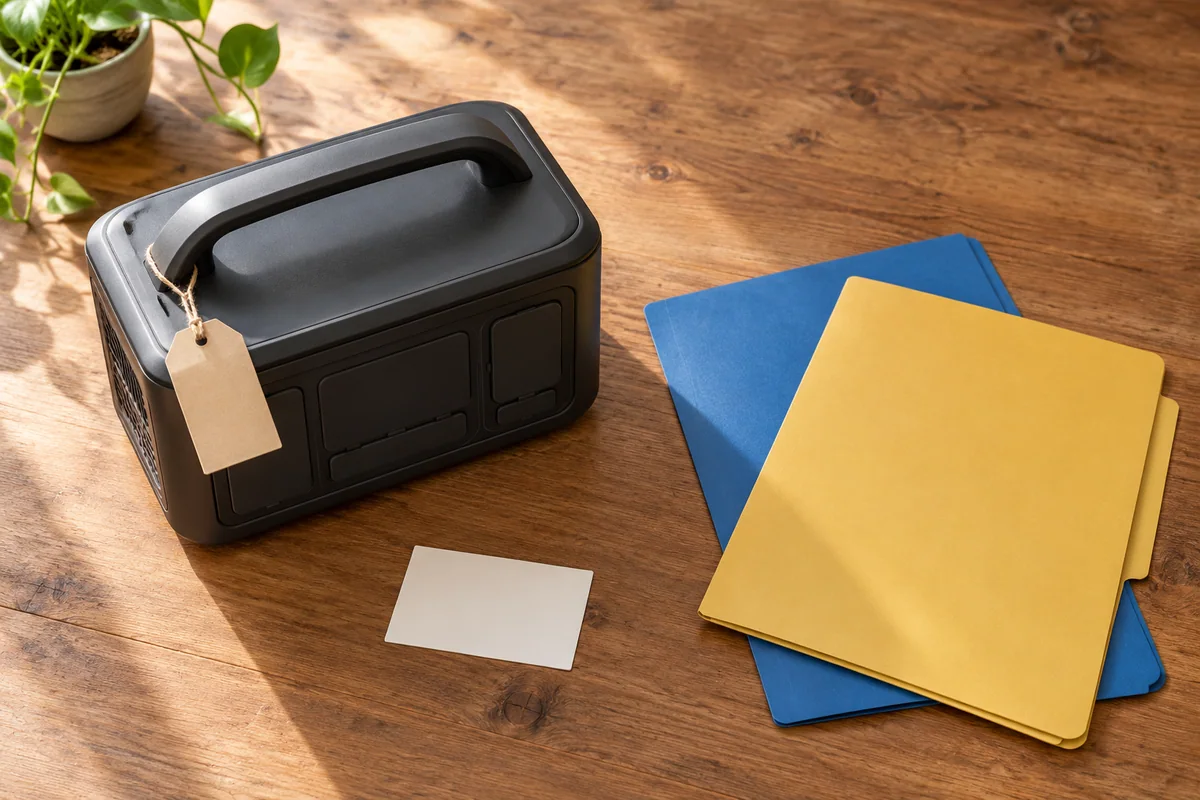
When two suppliers use different names for an apparently similar finished battery product, resolve the identity before comparing their prices. Keep the seller’s SKU, the manufacturer’s exact model and the document identifiers in separate fields. Ask for a written explanation of every alias instead of choosing whichever name appears most often.
The resulting register answers a limited question: what product does each supplier say it is quoting, and what evidence connects those names? Document authenticity, delivered-unit provenance, technical conformity and suitability still need their own reviews. A tidy register helps locate evidence; it does not perform those reviews automatically.
Preserve each identifier in its original role
Begin with a buyer reference that remains stable throughout the RFQ. Add the seller’s legal or trading identity as provided, the listing URL, the selected option text and the seller’s exact SKU. Preserve spelling, punctuation and suffixes. Keep a normalized search term in a separate helper field if useful, without overwriting the original identifier.
Next record the manufacturer named by the supplier, the manufacturer’s model, any relevant hardware revision and the regional or configuration variant. If the supplier cannot identify a revision, record “not supplied.” A blank revision is different from an affirmative statement that a manufacturer does not use a separate revision designation.
Ask what each number represents. A seller’s internal stock code, a product-family name, a manufacturer model and a serial number serve different roles. A document number identifies evidence, not necessarily the purchased model. Confusing them can make one valid document appear to cover a product that it never names.
Build an identity register before requesting equivalence
The following is a reusable field set. It requests an explanation from the supplier rather than assuming that any two identifiers are aliases.
| Register field | What to retain | Question that closes the field |
|---|---|---|
| Buyer reference | Stable RFQ line ID | Which line in the quote does this answer? |
| Seller identity and SKU | Exact seller name, listing option and stock code | Is this code specific to the offered variant? |
| Manufacturer identity | Manufacturer name as stated in primary documents | Who is responsible for the model designation? |
| Manufacturer model/version | Full model, suffixes and any applicable revision | Which exact configuration will be supplied? |
| Nameplate evidence | Clear, attributable label image or approved label record | Is this a representative example or evidence for the quoted goods? |
| Technical document | Document title, issuer, ID, revision/date and model scope | Where does it identify this model? |
| Alias explanation | Dated cross-reference and the party issuing it | What evidence supports the seller-to-manufacturer mapping? |
| Decision | Mapped, unresolved, alternative or superseded | Who reviewed it, and what remains outside that review? |
Put the quote date and the evidence-received date in the register. Preserve earlier versions if the seller later edits the listing. A current listing alone cannot explain which variant an older price referred to.
Ask for a manufacturer-backed cross-reference
When the listing and manufacturer document disagree, send the exact mismatch back. Ask the supplier to obtain the manufacturer’s explanation of the relationship between the seller SKU and the manufacturer’s model, including any revision, private-label or configuration limitations. For a private-label offer, request the responsible parties’ documented mapping rather than assuming that rebranding preserves every technical characteristic.
A useful response names both identifiers, describes what changes and what stays the same, identifies its issuer, and references the supporting document. An unexplained “same product” chat message leaves the mapping unresolved. Do not infer a common factory from identical case photographs or equal nominal capacity.
Check the scope of the explanation. A mapping for one color or market version should not automatically be copied to every option in the listing. Likewise, a relationship between two finished-product names may not identify the battery model inside the product. Ask which level each document covers and leave any missing connection visible.
Why the document relationship matters
One narrow primary-source observation explains the need for precise identifiers. IATA’s 2026 battery guidance lists model numbers within the cell/battery description in its test-summary information, alongside manufacturer and report identifiers. A name mismatch can therefore affect the next reviewer’s ability to connect evidence to the product. IATA 2026 guidance, printed page 9
This article does not reproduce a transport-document checklist or establish a shipping classification. The guidance itself says it is not a source of regulatory compliance. Pass the resolved identity record and any remaining mismatch to the qualified logistics reviewer; let that reviewer determine what the actual shipment needs. Do not rename the goods in the purchasing record merely to match a convenient PDF.
A fictional alias mismatch with a bounded outcome
Assume buyer reference BAT-01 requests a finished battery identified in the buyer’s documents as fictional Model M, revision R2. Seller A quotes SKU A-42 and supplies a datasheet for Model M-R2. Its label image reads A-42, but no manufacturer cross-reference explains that label. Seller B quotes Model M-R1. Every identifier in this example is fictional, and no genuine manufacturer alias or supplier relationship is asserted.
A’s record has a plausible technical-document match but an unresolved label-to-model relationship. Record both facts. Ask for a manufacturer-backed explanation connecting A-42 to M-R2 and describing the supplied configuration. Do not mark identity complete simply because the energy figure in the listing resembles the datasheet.
B has offered a different revision from the requested one. Keep it as a separate alternative and ask for the documented differences and a review by the responsible project owner. Do not change the requirement to R1 just to make both offers look comparable.
Neither result proves that a seller is dishonest or that either product is unsuitable. The next action is specific: close A’s alias mapping and assess B’s proposed revision change. Only after those decisions can the price comparison accurately state which offers answer the same product request.
Keep the approval narrow and reversible
Use “mapping supported by the listed evidence” as a precise record status. Record the reviewer and date, but also retain outstanding authenticity, technical or supply-chain questions. Avoid a single green “verified” cell that conceals which checks were actually performed.
Hold the relevant comparison when the offered model has unexplained suffixes, the manufacturer is not identified, an alias statement covers another configuration, or a new quote quietly changes the version. Ask for a corrected reply with the same buyer reference and an explicit change record. Independent lines can continue through review without erasing the held line.
If a supplier proposes a substitute, create a new offer record linked to the original requirement. Preserve the old model, old document set and reason for the change. A new enclosure label or a replacement PDF should trigger a check of the mapping, even when the seller says the price is unchanged.
Finish the RFQ with one accepted identity statement per offered variant and a visible list of unresolved relationships. Supply that same statement to the people reviewing specifications, samples and later shipment documentation. Consistency at this stage makes discrepancies easier to locate without pretending that an identity register guarantees the goods that will arrive.
Frequently asked questions
Does a matching photograph establish the same battery model?
No. Ask for exact identifiers and primary documents, plus an attributable explanation of any alias. A photograph alone does not establish the relationship.
Can an alias register authenticate a certificate?
No. It connects claimed identities and evidence locations. Authentication, applicability and technical conformity are separate checks by the appropriate parties.
What if the manufacturer uses no revision code?
Record the manufacturer’s statement and preserve the document version, date and supplied configuration. Do not invent a revision or treat missing information as confirmation.
Should a revised model replace the old row?
Keep a separate offer linked to the original requirement and retain the change history. The responsible owner must decide whether the revised model is acceptable.
Sources
Discuss a sourcing request related to this article.Match Battery Model Aliases Before Comparing Supplier Quotes