
Keep Optional Extras and Spares Separate from Required Kit Parts
Separate required contents, included optional extras and approved spares with a role-and-allocation sheet for each passive kit configuration.
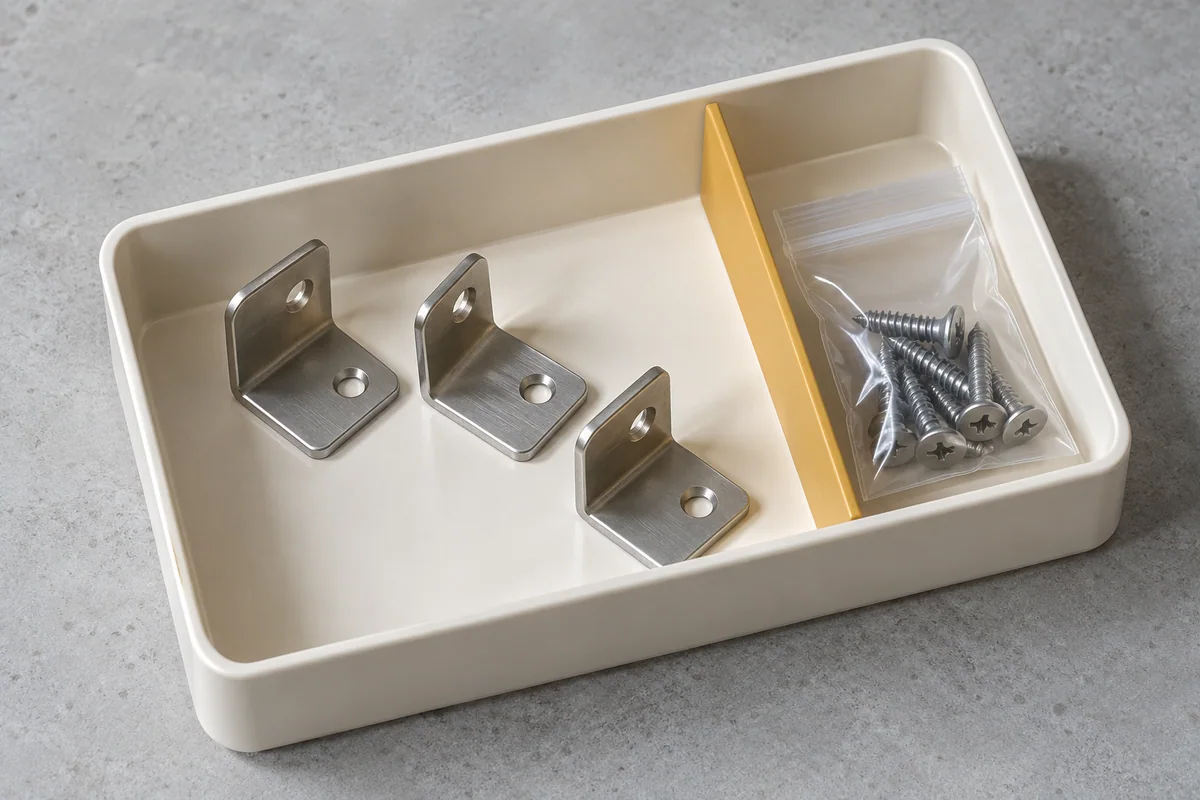
Give every kit component an explicit role: required content, an included optional extra, a separately selected option or an approved spare. Then decide how those roles will remain visible in the packed kit. An extra item should not force the recipient to guess whether it was omitted from the instructions or belongs to another version.
The deliverable is a required/optional/spare allocation sheet tied to the approved kit references. This article describes an editorial method for passive components. It does not set a spare allowance, change the product design or interpret a warranty. No actual contents list, spare policy or instruction file was supplied.
Separate inclusion from intended use
An item can be optional for the recipient to use while still being required in the purchased package. If the buyer-approved contents list includes an optional divider in every kit, the packer needs to include that divider in every kit. Calling its use optional should not make delivery optional.
Conversely, a separately selected option belongs only to the configurations for which it was approved. Keep the option selection in the kit definition instead of treating every available accessory as part of the base kit. If the selection is unknown, label that kit configuration unresolved rather than filling it from a promotional photograph.
A spare is another distinct role. Record the exact approved spare component and quantity, and identify which required component it relates to when that relationship is part of the approved information. Do not infer interchangeability from appearance. A spare designation cannot supply missing product compatibility or safety evidence.
Use two fields when necessary: whether the component is included in this sales configuration, and how the buyer describes its intended role. This prevents one ambiguous word, “optional,” from carrying two different decisions.
Obtain quantities from the authorized contents list
Copy the required and spare quantities from the buyer-approved record. If a requested spare quantity has not been approved, leave it open. A round percentage or a supplier’s usual allowance is a proposal, not the buyer’s accepted requirement. This packing decision does not establish loss rates, reliability or future replacement needs.
When the same component appears in required and spare roles, retain separate allocations even if it has the same part number. The total physical amount is useful for planning, but the recipient-facing grouping still needs to distinguish the roles. Keep those two views linked so a reviewer can reconcile the sum without erasing its meaning.
Also record intentional exclusions. If an optional accessory is sold separately, state that in the controlled contents record where appropriate. Use approved recipient wording for any package label or insert. Do not add new statements about compatibility, assembly, support or entitlement merely to make the pack look complete.
Build the allocation sheet
Use one row per component-role combination. A repeated component identifier is appropriate when its required allocation and spare allocation differ. The following columns are a proposed buyer worksheet, not a mandatory standard.
| Field | What the buyer should specify | Decision it prevents the packer from guessing |
|---|---|---|
| Kit configuration | Exact kit ID, option selection and revision | Which contents list applies |
| Component identity | Approved exact part reference | Whether similar-looking parts are equivalent |
| Inclusion status | Included, excluded or awaiting decision | Whether the item belongs in this package |
| Content role | Required, included optional-use item or spare | How the recipient should interpret its presence |
| Quantity | Pieces per kit for this role | Whether an extra quantity is intentional |
| Physical allocation | Named pouch, compartment or other approved position | Whether extras may be mixed with required parts |
| Recipient wording | Approved label or insert reference and revision | How the role will be communicated |
| Approval and open question | Named owner, decision and remaining gap | Who may change the allocation |
Avoid combining unrelated spare items under “assorted extras.” A buyer needs to know which component and quantity that phrase covers. If a supplier wants to add a promotional part, treat it as a proposed change with a defined identity and purpose, rather than a welcome surprise that bypasses the contents record.
Work through a fictional washer allocation
Assume fictional kit K-W revision B specifies six washers W-1 in a required pouch and one additional W-1 in a separate spare pouch. The buyer has expressly approved both quantities for this example. Nothing here recommends seven washers for a real kit or a general spare percentage.
One kit therefore contains 6 + 1 = 7 W-1 washers, with two different roles. A fictional planned batch of forty identical kits requires 40 × 6 = 240 washers in required allocations and 40 × 1 = 40 in spare allocations, for 280 in total. This is planned membership arithmetic, not a receiving count or an inventory-purchasing recommendation.
A proposal to place all seven washers in the required pouch reaches the same physical total but loses the approved separation. The buyer should ask for the intended spare arrangement or authorize a revised presentation and wording. If the required pouch instead contains five while the spare pouch contains two, the total of seven still fails the fictional six-plus-one allocation.
Now suppose the kit also offers divider D-2 as a separately selected option. The forty-kit base scenario does not automatically require forty dividers. Create an option-specific configuration only after the buyer supplies the selected quantity and inclusion rule. A kit photograph showing D-2 cannot answer that question.
Resolve contradictory words before choosing a pouch
Compare the approved contents schedule with the proposed insert and pouch wording. If the schedule says “one spare washer” while the insert lists seven washers without roles, ask the document owner whether the two statements are intended to describe the same configuration. Preserve the conflict until that owner resolves it.
Do the same when a label says “optional” but the ordered configuration includes the item in every kit. Ask for wording that makes the intended meaning clear without weakening the agreed inclusion. An editorial suggestion can be prepared for approval, but the packer should not improvise recipient instructions during packing.
If a spare has no approved use description, do not invent one. The packaging record can identify its quantity and assigned pouch while its recipient wording remains an open decision. Do not turn that administrative gap into advice to install a different component.
Approve the roles and their presentation together
Review the allocation sheet, layout and relevant recipient information as one connected decision. Confirm that required contents remain identifiable, included extras have a defined location, and each spare retains its approved identity and quantity. Ask the packing provider to acknowledge the arrangement and flag unresolved execution details.
Record the approved kit version and the exact scope of the decision. A future change to spare quantity, option selection or wording should reopen the affected allocation. Keep previous versions available so an unexplained extra does not become the default for every later kit. The finished sheet establishes what is planned to be supplied and how its role is communicated; it does not prove packing completion or authorize product substitutions.
Frequently asked questions
Can an optional-use extra still be required in every package?
Yes, when the approved sales configuration includes it. Separate inclusion in the purchased package from whether the recipient chooses to use the item.
How many spare parts should a kit contain?
Use the exact buyer-approved quantity and component identity. This article supplies no default percentage, reliability allowance or inventory recommendation. An unapproved quantity remains an open decision.
Can required parts and identical spares share one pouch?
That requires the buyer to approve how their roles will be communicated. A correct combined quantity does not automatically satisfy an agreed separation or recipient-information requirement.
What if the insert and contents schedule describe extras differently?
Retain the conflict and ask the responsible document owner to reconcile the applicable versions. The packer should not invent wording, change inclusion or decide technical compatibility to make the records agree.
Discuss a sourcing request related to this article.Keep Optional Extras and Spares Separate from Required Kit Parts