
Plan Separators for Nested Empty Enclosures
Map nesting orientation, protected contact zones, separator references and removal access before approving a plan for empty DIY enclosures.
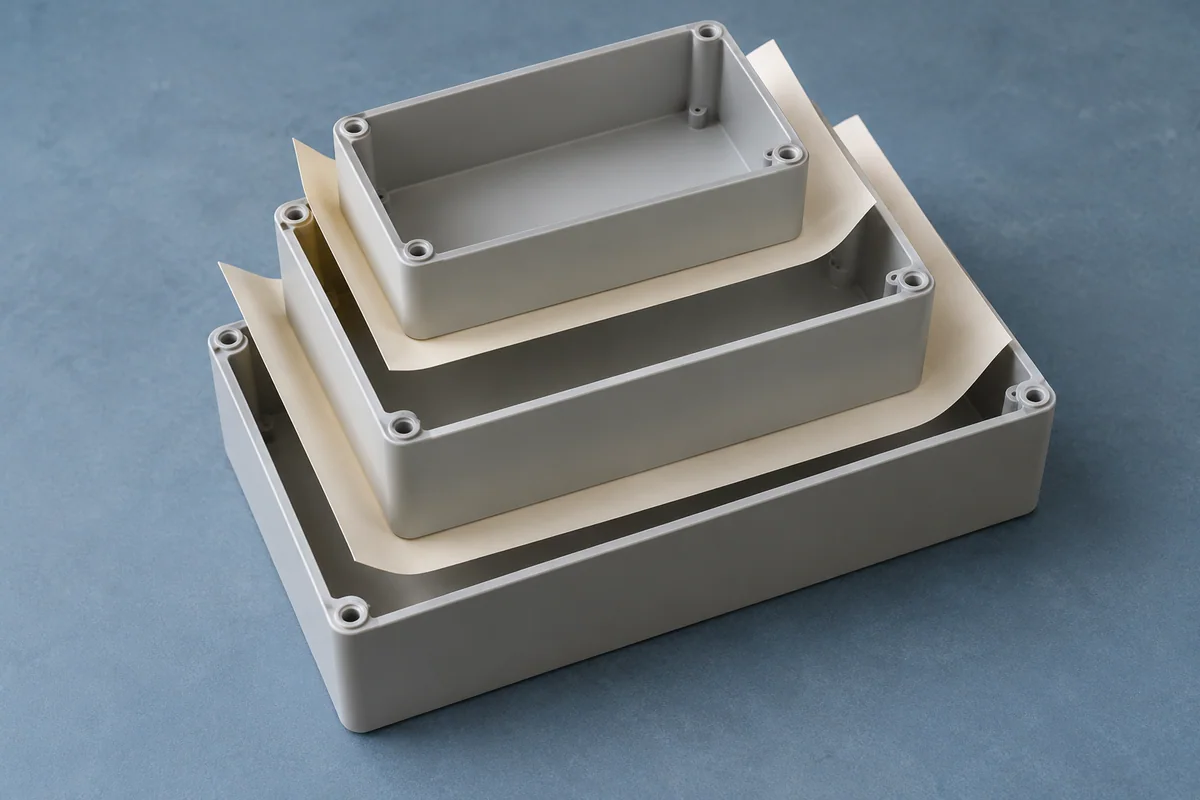
Approve nesting only after the proposed arrangement identifies where every empty enclosure may touch, which surfaces must remain separated and how the recipient will remove each shell. A photograph of bodies fitting inside one another leaves these decisions open. The useful deliverable is an annotated nesting proposal with explicit review gaps.
This planning method concerns empty passive enclosures. No actual product drawing, separator specification or packing trial has been supplied. It does not prescribe a nesting depth, removal force, material thickness or transport test, and it does not calculate freight savings.
Establish whether nesting is permitted at all
Ask the product owner whether the exact enclosure version may be nested. Record the drawing and finish references already approved for the product. Similar-looking shells may have different surface restrictions or features, so the packer should not extend permission from one model to a whole range.
Identify surfaces with an appearance requirement, permitted support zones and features that must remain unobstructed. If these are absent from the product record, request the owner’s decision. The packing proposal should show the missing input rather than quietly designate a visible face as a support surface.
Keep the alternatives open. Nesting, individual compartments and other arrangements can be separate proposals. The buyer can decline to pursue nesting while its key questions remain unresolved; the existence of an empty cavity is not permission to use it as packaging space.
Draw the contact relationships
Give the proposal a fixed viewing direction and label the outer and inner shells. Show the intended orientation and relative position using the authorized geometry. Include a side or section view where a top view hides a contact. References should lead back to the actual drawing, rather than a sketch becoming an unofficial dimension specification.
For each neighboring pair, mark proposed contact zones, required separation and unresolved areas. Include the first shell’s contact with its support and any contact between the nested group and surrounding packaging. A plan that addresses only shell-to-shell contact can still leave an approved face against an unspecified pack surface.
Separate two questions: where does the separator sit, and how is its position maintained in the proposed arrangement? A loose sheet shown in the right place does not explain whether its edge can move away from the protected area. Ask the packaging owner to address retention without assuming that adhesive, extra compression or a tighter fit is authorized.
Use a nesting arrangement proposal
Create one row per distinct contact relationship. Repeat the row when a different shell, orientation or separator is proposed.
| Proposal field | What the buyer needs to see | Question to keep open if absent |
|---|---|---|
| Product coverage | Exact empty-shell model, drawing and finish revision | Which product configuration does this cover? |
| Arrangement | Identified inner and outer shells, orientation and planned nesting position | Has the product owner allowed this relationship? |
| Protected areas | Marked faces, edges and features that must remain separated | Is contact here permitted? |
| Contact zones | Proposed support/contact surfaces and their authorization | Who approved the support location? |
| Separator | Exact material reference, shape revision and placement | Is contact-material suitability supported? |
| Position control | Proposed means of keeping separation in the intended areas | Could a required interface become uncovered? |
| Removal access | Intended access points, sequence and responsible reviewer | Can removal occur within the authorized method? |
| Approval boundary | Geometry, material, removal and performance decisions separately recorded | Which decisions still lack evidence? |
Use status words that describe the work: proposed, awaiting product input, awaiting material evidence, or approved for the stated review scope. Avoid one green cell labeled “packing approved” when only orientation has been considered.
Review removal before closing the arrangement
Ask the packaging owner to show the intended unpacking sequence for the approved passive configuration. The review should consider how the recipient identifies the next shell, reaches the permitted handling area and encounters the separator. A separator that becomes hidden inside the remaining shell needs an explicit disposition in the plan.
Define who may conduct a physical review and which approved method applies. If a mockup cannot be separated by that method, stop that review and refer the arrangement back. Do not improvise pressing, levering, pulling harder or using tools to make the proposal appear workable. This article supplies no force limit or extraction technique.
Record whether the reviewed object used the intended product and packaging revisions. A substitute shell or placeholder sheet may answer a limited layout question, but its differences remain visible in the record. Ask the reviewer which conclusions transfer and which require the intended configuration.
A hypothetical nesting decision
Consider two fictional empty display enclosures, outer shell E-41 and inner shell E-42. The product owner’s invented baseline marks the outer shell’s inside display face as protected and permits support only at a specified rim. Proposed layout A places the inner shell against the protected face, with an unspecified sheet between them.
The buyer should return layout A for revision. The sheet’s presence does not resolve the unauthorized support location. Asking only for a thicker sheet would skip the more basic question of whether that contact relationship is allowed.
Layout B shows a separator arrangement referenced to the permitted rim and leaves the display face separate. Its geometry can proceed to the designated review, while exact separator compatibility and recipient access remain open. If the access review cannot identify an authorized removal sequence, the buyer can ask for a non-nested alternative instead of approving a forced-fit workaround.
For another purely hypothetical completeness check, a straight stack of four shells has three adjacent shell-pair interfaces: 1–2, 2–3 and 3–4. Three interface rows do not establish three adequate separators. One interface may need several defined pieces, and base or surrounding-pack contacts need additional rows. This arithmetic describes relationships only, without selecting stack height or protection.
Keep layout approval separate from transport evidence
ISTA’s public procedure descriptions distinguish early design screening from general simulations of transport hazards. That distinction supports keeping the review purpose explicit; it does not select a procedure for these enclosures. ISTA test-procedure overview
A layout review can establish which proposal the buyer wants developed. Any claim about protective performance requires the responsible packaging owner to define the applicable configuration, evidence and acceptance basis. No test has been selected or performed here.
Finish with one dated proposal showing the authorized product references, permitted contact map, proposed separators, removal-review outcome and unresolved decisions. When any of those changes, identify the affected relationships before reusing the approval. The buyer should be able to tell exactly what can proceed without mistaking an orderly nested arrangement for a completed protection assessment.
Frequently asked questions
Does a successful nesting photograph approve the pack?
It can illustrate an arrangement. Product permission, permitted contact zones, separator suitability, removal access and any required performance evidence still need their own decisions.
How many separators are needed for four shells?
The answer depends on the approved contact map and separator design. Four shells in a straight stack create three adjacent pair interfaces, but that does not determine the number of separator pieces or address contacts with the surrounding pack.
What if shells need extra force to separate?
Stop the review if the approved removal method cannot be followed and return the arrangement to its owner. Do not invent a force limit or improvise tools or forced separation.
Can the same plan cover another enclosure size?
Only with an authorized review of the changed geometry, protected surfaces, contact relationships, materials and access. Similar appearance does not extend the original approval.
Sources
Discuss a sourcing request related to this article.Plan Separators for Nested Empty Enclosures