
Request Evidence for Materials That Touch a DIY Product
Link each proposed pouch, foam, tape or interleaf to its exact product surface, stated contact conditions and evidence owner before material approval.
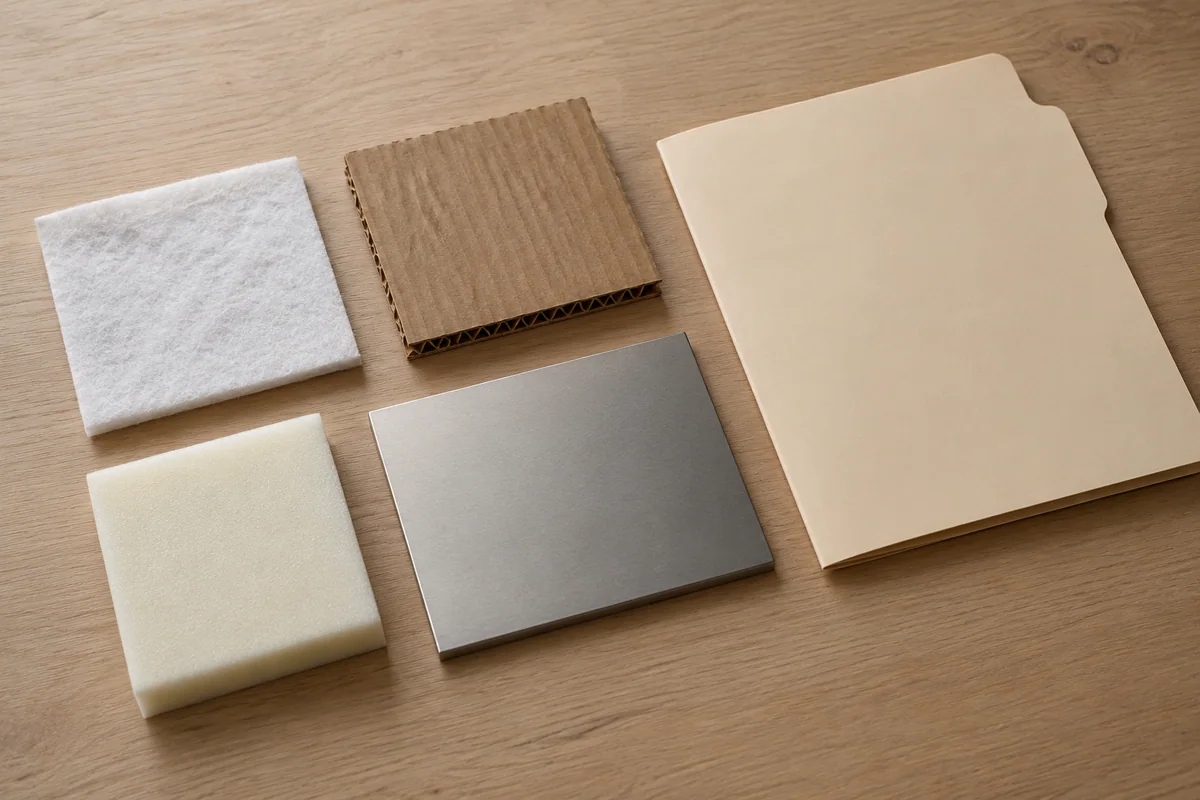
Request evidence for the exact packaging material where it will touch the exact DIY product surface. “Soft foam,” “protective tape” or “non-marking bag” leaves too much unspecified for a contact decision. A useful approval register connects a material reference, surface, conditions and supporting evidence, with a named owner for the unresolved questions.
The method below helps buyers organize that decision. No actual supplier datasheet, product-finish record or compatibility assessment has been supplied. It offers no universal safe-material list and does not select chemicals, conduct testing or establish electrical, food-contact, corrosion, fire or environmental properties.
Describe the contact before requesting a document
Start with the approved packing layout and identify each direct product-contact location. Give a pouch around a finished panel a different row from a tape that closes the outer pouch without touching the panel. Record the intended contact rather than assuming all materials in the package have the same exposure.
For each row, identify the exact product surface from its authorized drawing or finish reference. “Metal” is insufficient when the actual contact is with a named coating, print or existing protective layer. If the surface identity is unknown, the evidence request should say so; a material supplier cannot meaningfully confirm an unspecified combination.
Describe the intended conditions that the responsible owner has established: expected contact duration, relevant storage environment, any stated pressure or other exposure, and the planned separation or removal stage. Keep unknowns as questions. Do not copy numerical conditions from another project’s datasheet to fill empty cells.
Identify the material being proposed
Ask for the manufacturer, exact product or grade code, supplier identification, document revision and the form being supplied. For a converted item, identify the finished construction as well as the base material. A pouch’s closure or printed area, for example, belongs in the contact description if it may touch the protected surface.
Retain the complete supplier response. A distributor’s sales phrase can help locate a candidate but should lead to an identifiable technical source. If the offered material has no traceable code or the supplier reserves the right to use an unspecified equivalent, keep that uncertainty visible before approval.
A color or texture in a sample photograph does not identify the material formulation. Avoid requesting a matching color as a substitute for a controlled reference. Likewise, a document for one family member cannot silently cover every item sold under the same broad family name.
Read evidence for its actual scope
Nitto’s official selection guidance treats application, processing, storage and peeling as distinct functions. Its storage discussion specifically includes heat, pressure and ultraviolet exposure in relation to protected-surface condition. This is useful evidence that a film-selection question extends beyond its appearance at the moment of application. It does not establish that a particular film, foam or pouch suits the buyer’s product. Nitto surface-protection selection guidance
Ask what each offered document actually addresses. A product description identifies a candidate. An applicable technical statement may describe intended surfaces and conditions. An assessment record may support a stated conclusion for a defined combination. Keep those roles separate and preserve the document’s qualifications.
Where a report is offered, ask the responsible reviewer to identify the material tested, substrate or finish, conditions, observation scope and stated conclusion. A favorable result on an unrelated surface leaves the buyer’s contact question unresolved. Do not translate “no concern reported in this evaluation” into a universal guarantee.
Build a contact-material approval register
Use the following fields for each material-to-surface relationship. One material touching two different finishes may need two rows, even when the supplier code is unchanged.
| Register field | Record | Decision it enables |
|---|---|---|
| Contact location | Layout position and surfaces on both sides | Identify the actual interface |
| Product surface | Exact finish, coating, print or retained-layer reference | Determine whether the evidence concerns this surface |
| Packaging identity | Manufacturer, product code, construction and supplier reference | Prevent an unnamed substitution |
| Document control | Datasheet or statement title, revision, date and issuer | Identify the evidence actually reviewed |
| Intended conditions | Approved duration, environment and other relevant exposure; unknowns stated | Compare intended use with documented scope |
| Evidence applicability | Assessed material/surface/conditions and limitations | Separate relevant support from a generic document |
| Decision owner | Product/packaging reviewer and unresolved questions | Route the approval to the right person |
| Approved scope | Specific relationship, conditions and change triggers | Keep later reuse within the decision |
Avoid a single “certificate present” checkbox. A document can be genuine and still fail to answer this interface question. The register should make that distinction visible without claiming that a missing document proves the material unsuitable.
A hypothetical foam substitution
Suppose an invented packing layout uses foam code P-02 against passive panel finish F-17. The supplier sends a brochure for a foam family and a photograph of a white pad. Neither identifies P-02’s exact construction or evidence covering F-17 under the intended contact conditions.
The decision is “contact-material approval pending,” with a targeted request for the exact product identity, relevant technical documentation and the responsible owner’s assessment. It is premature both to approve the pad and to declare it damaging. The missing information is specific enough for the supplier to address.
Now suppose the supplier proposes P-03 instead and provides a statement covering another finish, F-12. Keep P-03 as a new candidate. Do not replace P-02 in the register while retaining the old approval status, and do not treat F-12 evidence as if it named F-17. The reviewer can ask whether additional applicable evidence exists or another arrangement is needed.
No materials in this example have been purchased, assessed or tested. The codes and surface references are fictional. The useful outcome is a bounded decision about what remains unsupported, rather than a purchasing recommendation based on a generic material name.
Define what changes reopen the decision
Record the reviewed contact pair and conditions beside the approval. Changes to the material code, supplier construction, product finish, retained film, direct-contact location or relevant use conditions should go back to the owner for an applicability check. The check determines what further review is needed; the register itself does not prescribe a test.
Keep additional claims separate. If someone asks whether a material is recyclable, electrostatic-protective or suitable for food contact, identify the exact claim and applicable evidence owner. Approval for contact with a cosmetic panel does not automatically answer those questions.
Hand the packer the approved material reference and the limits attached to it. If the required item is unavailable, the next step is an identified alternative for review, rather than a visually similar replacement. That preserves the connection between the buyer’s decision and what the proposed packaging actually uses.
Frequently asked questions
Can a generic foam or film name establish suitability?
No. Identify the exact supplied material, the product surface it touches and the intended conditions, then request evidence applicable to that combination.
Does missing compatibility evidence mean the material is harmful?
It leaves the contact decision unsupported. Record the missing evidence and responsible reviewer without inventing either a favorable or adverse result.
Can one approval cover every surface in the kit?
Only if its stated scope actually covers those surfaces and conditions. Give materially different contact relationships separate rows so gaps remain visible.
What if the packer proposes an equivalent material?
Record its exact identity as a proposed change and ask the approval owner what evidence is needed. A matching color, feel or general material name does not establish equivalence.
Sources
Discuss a sourcing request related to this article.Request Evidence for Materials That Touch a DIY Product