
Check Connector Housings and Accessories Against Ordered Contents
Reconcile received housings, contacts and accessories with the accepted contents list while preserving sealed-package and count limitations.
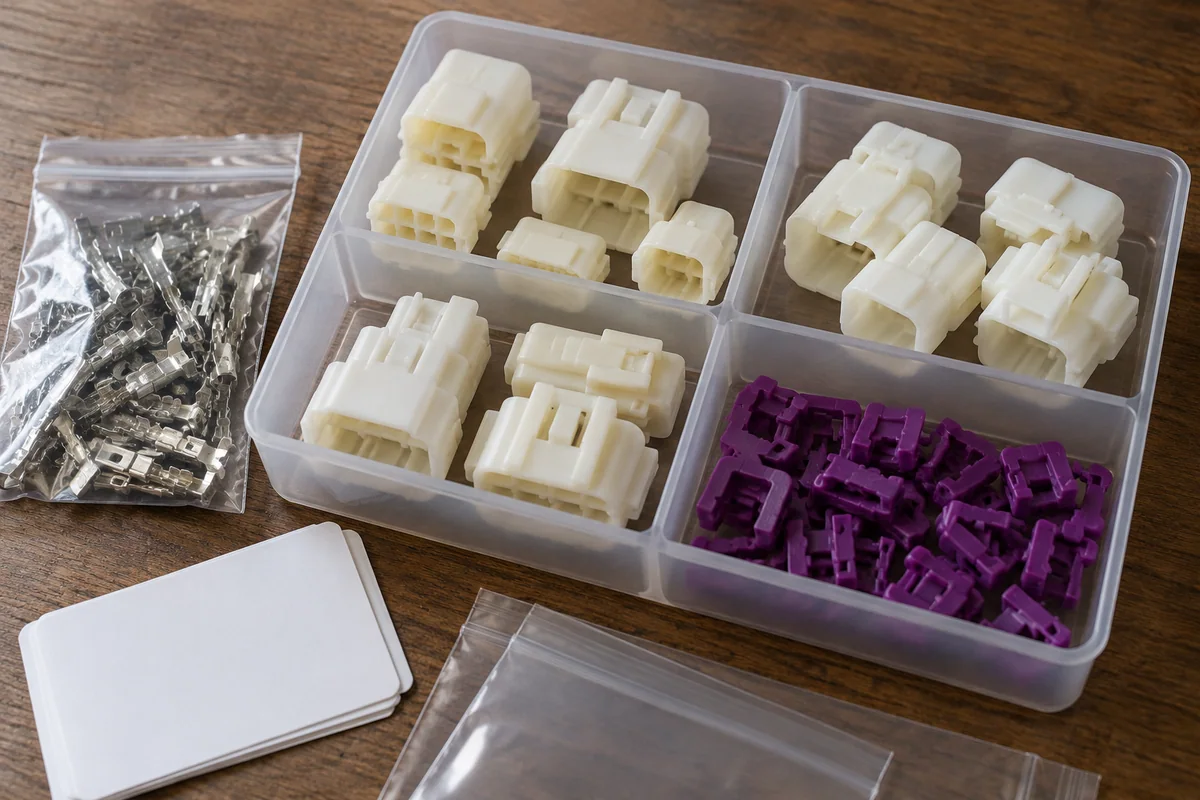
A connector delivery is complete only against an identified contents list. Count the ordered housings, contacts and accessories as separate deliverables, even when the supplier sells them under one kit name. A photograph of a similar assembled connector cannot settle whether the agreed lock, seal or contact package arrived.
The receiving task here is administrative reconciliation of disconnected passive components. It does not determine electrical suitability, authenticity or the correct mating combination. Those decisions require their own evidence and qualified approval. The actual order and arrival records have not been supplied; all receipt examples below are fictional.
Start from the accepted order contents
Retrieve the order revision, exact purchased part identifiers and the included-parts schedule accepted for that order. Keep the supplier’s kit or sales code separate from the manufacturer’s component references. If an approved bundle contains several items, expand it into component rows while retaining the bundle reference above them.
Use that accepted list as the baseline. A current catalog can help explain a component description, but it cannot retrospectively change what a seller agreed to include. An item pictured beside a housing may be optional, separately purchased or simply illustrative. Resolve the order record instead of counting everything in the marketing image as a promised accessory.
An official example shows the importance of product type: TE Connectivity identifies 1-480704-0 as a plug housing and provides a product-drawing link. That entry identifies a component; it does not state what a particular reseller’s bundle includes or authenticate a delivered unit. No mating relationship or electrical rating is adopted here. TE exact-part entry for 1-480704-0
Keep observation levels separate
Record what the receiving team actually observed. A sealed pouch labeled with a contact identifier is evidence that such a labeled pouch arrived. Unless its contents were checked under the agreed scope, it should not become a verified internal contact count. Likewise, a printed package quantity and a physically counted quantity belong in separate fields.
For each component, distinguish the ordered amount, the package-label statement, the observed package count and the verified piece count, if available. Write “not checked: pouch retained sealed” when appropriate. This is more useful than a blank cell or a presumed zero.
Respect the handling and opening scope. Receiving personnel should not dismantle an assembly or open protected packaging merely to make a spreadsheet complete. If the agreed work leaves the contents unverified, preserve the limitation and ask the responsible owner whether further authorized evidence is needed.
Use a component inclusion matrix
Each row should identify one ordered component and the received evidence that relates to it. Retain full suffixes and the original label text; do not simplify two codes until they look alike.
| Matrix field | What to enter | Question it resolves |
|---|---|---|
| Order/bundle reference | Accepted order line, revision and kit contents version | Which promise is being reconciled? |
| Purchased component | Exact identifier, description and required quantity/unit | What should be included? |
| Observed package | Receipt, carton and pouch or tray reference | Where was the evidence found? |
| Observed identifier | Label text or unit marking exactly as seen, plus image ID | Does the recorded identifier match? |
| Quantity evidence | Package count, stated contents and verified pieces separately | Which quantities were actually established? |
| Unopened scope | Sealed or inaccessible contents and why they remain unchecked | What has not been verified? |
| Discrepancy | Missing package, different code, count difference or ambiguous baseline | What requires an answer? |
| Authorized outcome | Decision owner, evidence and exact component/quantity covered | What can be considered reconciled? |
If several order lines share an accessory pouch, show the allocation explicitly. Do not assign the same contents to two kits. Equally, do not record a shortage merely because the accessories arrived in a different carton when the accepted arrangement permits shared packaging and the mapping is clear.
A label match is useful traceability evidence, but it does not prove that the contents are genuine or technically compatible. Keep any required authenticity or technical documentation checks outside the count result and identify their owners.
A fictional housing-and-lock set with a gap
Assume fictional order PO-C revision B includes ten H-10 housings and ten L-10 locks. A separate line calls for one sealed pouch of specified C-20 contacts, with its inner quantity to remain unverified under this example’s receiving scope. The identifiers and quantities are invented and do not describe a real connector configuration.
The receiving report records ten individually counted H-10 housings. It also records one sealed pouch whose label states C-20. No L-10 lock pouch is visible in the reported carton contents. The useful first outcome is: housing count recorded; contact pouch identity observed at label level only; ordered lock package not located within the reported scope.
Before calling this a confirmed lock shortage, ask whether another parcel or identified compartment remains outside that scope and request its status. If the provider confirms that all relevant packaging was checked as authorized and no locks were found, the matrix can record the supported omission. Preserve the distinction between “not located in the available evidence” and a completed contents check showing absence.
The supplier may reply that the locks were packed in a separate carton. Ask for that carton reference and link it to its own receiving event. A dispatch assertion does not show that the missing item has arrived. If the supplier instead offers L-11, record a different identifier awaiting the authorized owner’s decision; do not replace L-10 in the baseline.
Make a discrepancy request at component level
Send the supplier a concise record of the order line, component identifier, received package references, observed amount and missing evidence. Attach the relevant context and label images when authorized. Ask for an answer to the specific gap rather than a generic statement that the kit is complete.
For a code mismatch, retain both strings and request the supplier’s explanation with the applicable manufacturer evidence. A seller’s claim that two parts are interchangeable is a proposal for technical review. Receiving should not resolve that question by forcing pieces together, performing continuity or polarity checks, crimping contacts or connecting equipment.
For a missing component, record whether the supplier proposes a separately identified delivery, a correction to the report or a change to the ordered contents. Keep commercial remedies and replacement-shipping costs in the appropriate purchasing record. The inclusion matrix establishes what is accounted for; it does not calculate a refund entitlement.
Close only the contents question supported by the record
When further evidence arrives, update the affected row and keep the earlier observation available. If a previously missing pouch arrives later, give it its own receipt reference and reconcile its exact identifier and quantity on the agreed basis. Do not backdate its arrival to make the first shipment appear complete.
Before closing the contents review, look for unresolved package-level counts, ambiguous component codes and accessories allocated more than once. Ask the decision owner to identify any intentionally accepted omission or substitution, with the specific order line and amount covered.
The final statement should be narrow enough to audit: the listed components and quantities were reconciled under the stated receiving scope, with sealed contents and unresolved rows identified. That statement can support an administrative completion decision. It does not authorize assembly, mating, energizing or installation, and it cannot certify internal battery safety or product compliance.
Frequently asked questions
Are contacts automatically included with a connector housing?
Use the accepted order and included-parts list. A housing identifier or catalog photograph does not establish what a particular seller agreed to include.
Can a sealed pouch be counted as verified contents?
Record the observed pouch and its label separately from internal pieces. If it remains sealed under the receiving scope, keep the internal count unverified.
When is an accessory confirmed missing?
When the relevant authorized contents check and receipt mapping support its absence. Not appearing in one photo or checked location can leave other packages unresolved.
Does a complete connector kit establish compatibility?
No. Contents reconciliation does not approve authenticity, the mating combination, electrical use or installation. Those need the applicable evidence and qualified decision.
Sources
Discuss a sourcing request related to this article.Check Connector Housings and Accessories Against Ordered Contents