
Prepare a Fit-Check RFQ for a Finished DIY Enclosure
Request usable interior space, mounting geometry, lid scope and exact drawing evidence before comparing finished DIY enclosure quotes.
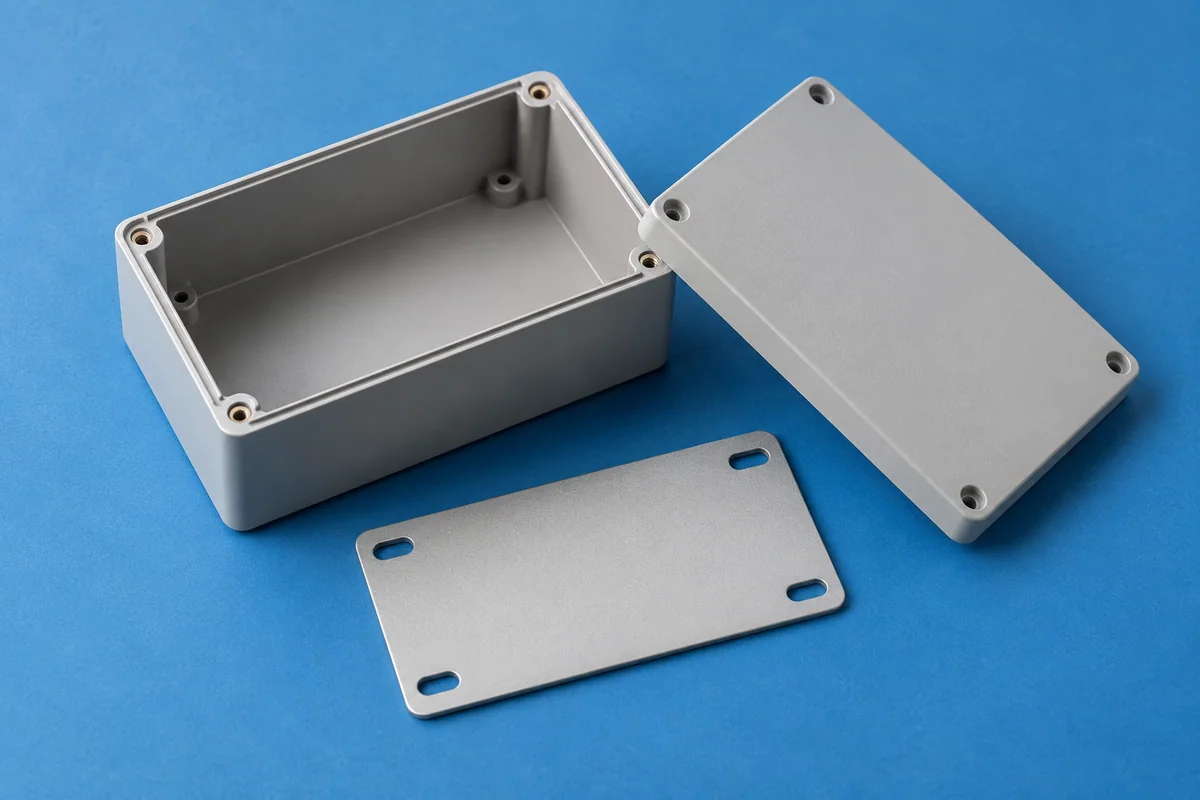
For a finished DIY enclosure, ask the supplier to quote against the space and interfaces the project actually needs. Outside length, width and height are useful screening dimensions, but the fit decision also depends on the usable interior, lid arrangement and mounting geometry. Put those questions into the RFQ before selecting a supplier.
Start from the buyer’s approved layout and requirements. This article covers procurement of a finished passive enclosure, not designing a battery box, selecting electrical clearances or authorizing a modification. The responsible project owner must specify any safety, thermal, structural or access requirements. If those inputs are missing, leave the selection open.
Define the object whose dimensions are being quoted
Record the exact enclosure part number and supplied configuration. Does the offer include the box and lid, a mounting plate, feet, flanges, gaskets or other accessories? Which components are separate options? Ask the supplier to distinguish the manufacturer’s standard product from any modified version.
For each dimension, state what it measures. Overall closed height, box-only height and usable interior height are different questions. A dimension can be correct and still answer the wrong one. Record whether an external envelope includes projecting features, and ask how the relevant assembly is represented in the official drawing.
Do not rely on a rectangular volume calculated from three headline numbers. A fit review needs the actual relevant space and obstructions. The supplier should identify where dimensions apply, while the project owner decides whether the resulting geometry meets the approved layout.
Send a compact dimension request pack
Use an authorized requirement sheet, the exact manufacturer drawing where available, and a question log. Give each requested dimension a reference so the supplier can answer it without marking unrelated dimensions as checked.
| Dimension group | RFQ question | Evidence to request | Who decides suitability? |
|---|---|---|---|
| Closed external envelope | What maximum space does the supplied assembly occupy, including specified accessories? | Exact-part dimensioned drawing and configuration | Buyer/project owner |
| Usable interior | What space is available in the required region with the lid closed? | Relevant sections and identified obstructions | Responsible designer |
| Mounting interface | Where are the required mounting features relative to stated reference surfaces? | Dimensioned hole/boss/plate view with units | Responsible designer |
| Lid and closure | Which lid is quoted and what geometry affects the approved layout? | Box/lid drawing and included-parts statement | Responsible designer |
| Required access | What access or removal envelope has the buyer specified? | Buyer requirement and supplier response | Qualified project owner |
| Evidence identity | Which part, document and revision supports each answer? | Manufacturer document title, revision/date and source | Buyer checks traceability |
The table does not set a tolerance or invent a minimum clearance. It asks for the information needed to compare the offered finished product with requirements established elsewhere. Use “not dimensioned in the supplied drawing” when a requested feature remains unanswered.
Learn from an official drawing without borrowing a fit approval
Hammond’s official drawing for enclosure 1591XXSSBK provides a concrete documentation example. The reviewed sheet distinguishes inside height, inside width and inside length from box and lid dimensions, and shows separate inside-box and inside-lid views. It also identifies a maximum PCB outline as not supplied with the enclosure. Those labels prevent a buyer from treating every number or depicted object as the same kind of deliverable. Hammond 1591XXSSBK drawing
The reviewed sheet does not show a conventional revision identifier in the extracted text. Record the exact file and retrieval date, and ask the manufacturer to confirm the applicable revision for any actual order. This example establishes how that document separates geometry and scope. It does not establish fit for a project, authorize electrical use or confirm any reseller’s goods.
For the general drawing-language context, ASME’s public Y14.5 description concerns stating and interpreting dimensioning and tolerancing requirements in drawings and related model data. The paid standard was not accessed here. No default tolerance, datum scheme or compliance claim is inferred from its public description. ASME Y14.5 public scope
Make reference surfaces and orientation readable
Ask the supplier to identify the view and surfaces used for any added measurement. “Hole spacing 60” leaves the units, feature pair and measurement direction unanswered. A response should connect the dimension to the relevant features on the applicable drawing, using the manufacturer’s terminology.
A buyer’s sketch can show the requirement, but label it as a requirement illustration rather than a manufacturer drawing. Keep it distinct from the official dimensional evidence. If the two conflict, ask the responsible designer to resolve the conflict before accepting the quote.
Request clarification where dimensions are omitted, approximate or derived from an unscaled image. Do not scale a web photograph to create a precise mounting pattern. A sample may help a separately agreed review, but a sample request should state which unresolved dimensions it is intended to answer; it does not automatically qualify every later unit.
A fictional outer-size match that leaves fit unresolved
Suppose the buyer’s approved passive-project layout names required interior region U and mounting pattern M. Two fictional suppliers quote enclosures with the same stated outside dimensions. Offer A includes only an external-size sketch. Offer B includes a dimensioned interior section and a mounting-feature view. No real enclosure, measurement or successful installation is represented in this example.
A has not answered the interior and mounting questions. B has provided material that can be reviewed, but it has not automatically passed. The responsible designer still needs to compare B’s geometry with U and M, confirm the supplied lid and accessories, and resolve any missing dimensions.
Record A as awaiting fit evidence and B as ready for the named fit review. Do not approve B merely because its PDF is more detailed. If B’s drawing applies to another suffix or an optional mounting plate, the evidence-to-offer match must be corrected first. The outer-size match remains only an initial screen for both candidates.
Close the enclosure RFQ at the correct boundary
Ask each supplier to return its exact part number, configuration, included items, drawing identity and explicit unanswered requirements. If a seller proposes drilling or machining to obtain the needed fit, treat that as a changed supply scope requiring separate authorized drawings and review. Do not let an unexplained modification remain hidden inside a standard-enclosure price.
Hold selection when a required interior region is undocumented, the mounting features cannot be located from clear references, the lid/configuration differs, or the project owner has not approved the relevant constraints. Also hold when the answer relies on an approximate measurement but the requirement needs a specified bound. The buyer should not supply an invented tolerance to make the quote appear complete.
Keep the accepted dimensional evidence beside the quote and record the reviewer responsible for fit. A future change to the enclosure, lid or mounting accessory should reopen the affected comparison. The RFQ is ready when it states what geometry is being supplied and what remains to be approved, not simply when two offers share the same outside dimensions.
Frequently asked questions
Are outside dimensions enough to choose an enclosure?
They can screen candidates, but they do not answer every interior or mounting question. Compare documented geometry with the approved project requirements.
Can I measure the product photograph to obtain missing dimensions?
Do not treat an unscaled photograph as a precise dimensioned drawing. Ask for exact-part evidence or an explicitly scoped measurement that the responsible reviewer accepts.
Who sets the clearances and tolerances?
The responsible qualified project owner or designer. This RFQ checklist does not supply electrical, thermal or structural clearance values or default tolerances.
What if the standard enclosure needs new holes?
Treat modification as a changed supply scope. Obtain authorized requirements and a separate review before relying on a quote for the modified configuration.
Sources
Discuss a sourcing request related to this article.Prepare a Fit-Check RFQ for a Finished DIY Enclosure