
Group Passive Fasteners by the Buyer’s Approved Kit Stages
Create a pouch-to-instruction map that keeps approved fastener groups identifiable without inventing assembly steps or confusing totals with allocation.
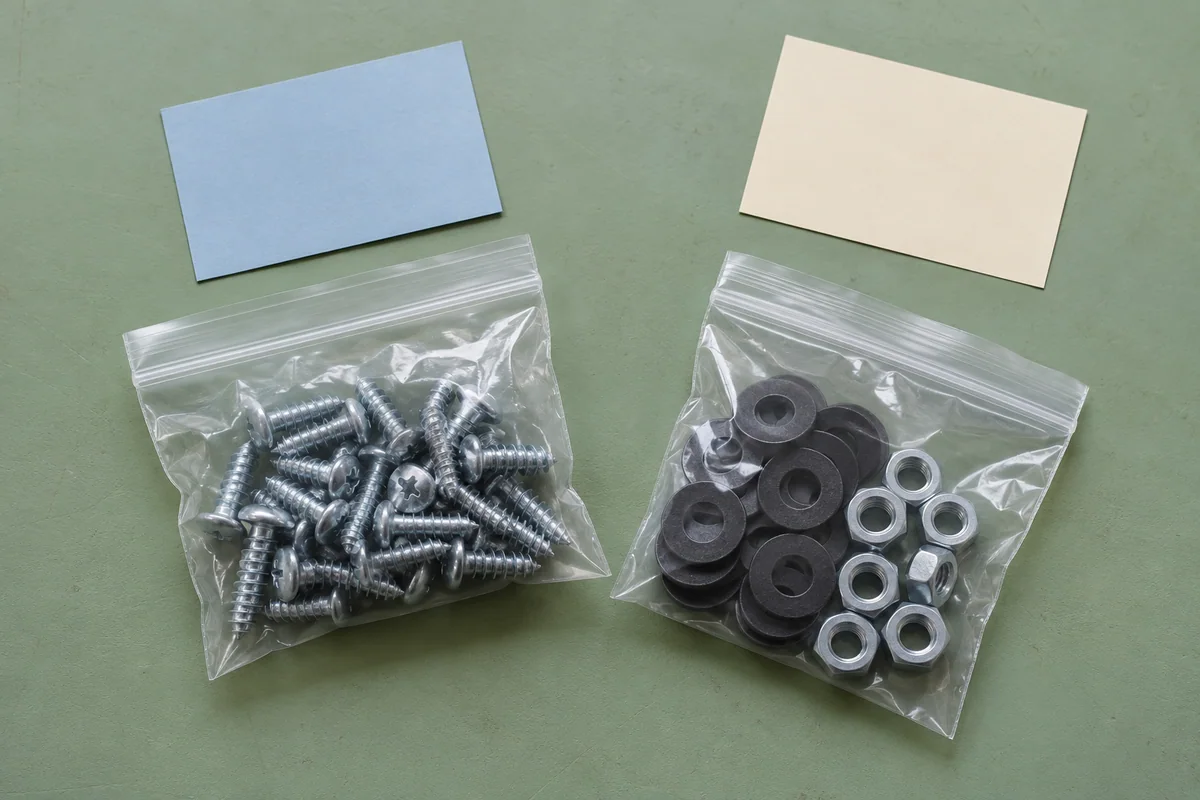
Group passive fasteners around the buyer’s existing, approved instruction references. Decide whether one mixed pouch, several identified pouches or another approved grouping best preserves those references when the recipient opens the kit. A pouch arrangement should make the approved contents easier to identify without creating a new assembly sequence.
The working document is a bag-to-instruction map. It connects each pouch to exact component references, quantities, kit version and instruction version. This is an editorial planning method, not a technical fastener-selection procedure. Actual instructions, product contents and packing records have not been supplied; all identifiers below are fictional.
Confirm what the instructions already authorize
Begin with the buyer-approved kit contents and instruction file. Identify the references used for parts and any existing groups. Preserve the manufacturer’s or buyer’s exact component identifiers, including meaningful suffixes. A friendly pouch name can sit beside those identifiers, but should not replace them.
Ask the instruction owner whether the proposed pouch grouping corresponds to an existing group, a named stage or no sequence at all. A packer should not infer assembly order from the layout of a photograph. If the instructions have no grouping, request a packaging identification decision without inventing steps, torque values, substitutions or a technically preferred fastener.
Record which instruction revision the decision uses. An older file may assign the same reference to a different quantity or group. “Use the latest instructions” leaves the packer to choose among files; an exact revision and issue date gives the map a reviewable baseline.
Choose the grouping on a stated basis
A combined pouch is a candidate when the approved instructions already identify its contents adequately and the buyer accepts the recipient’s sorting task. Separate pouches are candidates when the buyer wants particular groups kept distinct. Neither choice is automatically correct for every kit. Ask what identification decision the recipient must make, then obtain approval for the arrangement that supports it.
Lookalike components deserve explicit attention. Show the exact references in the map and ask the authorized product owner how the recipient is meant to distinguish them. If the answer depends on a feature not visible through the proposed pouch, record that limitation. Do not relabel one component as another because they appear similar or because their overall count matches.
Keep a packaging constraint separate from an instruction constraint. A packer may propose fewer pouches for its process, while the instruction owner expects separately identified groups. The buyer needs to reconcile that conflict. An execution preference does not silently amend the approved recipient information.
Use a bag-to-instruction group map
The map should describe contents at component level. If one pouch contains several references, use several rows under the same pouch ID. Avoid a single entry such as “hardware, six pieces” when it hides which six pieces the group requires.
| Map field | Entry to agree | Reason for keeping it explicit |
|---|---|---|
| Kit and contents revision | Exact kit ID and approved component schedule | Keeps different kit versions separate |
| Pouch reference | Unique local reference within the kit | Connects the physical group to the map |
| Instruction reference | Exact file, revision and approved group reference | Shows where the recipient finds the association |
| Component and quantity | Exact part ID and pieces per pouch | Makes a correct group different from a correct overall total |
| Identification content | Approved text or symbol and its artwork reference | Prevents informal pouch names changing the meaning |
| Secondary cue | Proposed color, location or other agreed cue | Supports identification without replacing the reference |
| Placement | Intended compartment or position in the kit | Preserves the reviewed grouping during packing |
| Exceptions and owner | Unassigned parts, conflicts and decision owner | Keeps unresolved content out of an assumed group |
Use the same pouch reference in the layout and approved identification artwork. As an editorial design choice, pair a color cue with a readable reference rather than expecting color alone to communicate the group. Any specific accessibility, language or regulatory requirement needs its own applicable review; this suggestion does not establish compliance with one.
Work through an equal-total, wrong-group example
Assume a fictional passive organizer kit has instruction I-6 revision D. Its already approved groups G-A and G-B each contain two component references, F-A and F-B. These names do not specify a screw size or recommend how any real product is assembled.
The fictional map requires pouch P-A to contain four F-A pieces and two F-B pieces. Pouch P-B contains two F-A pieces and four F-B pieces. The per-kit totals are therefore six F-A and six F-B, distributed across two six-piece pouches.
A proposed alternative puts three F-A and three F-B in each pouch. Both pouches still contain six pieces, and the kit still totals twelve. Yet neither pouch matches its approved group. The decision is to reject that mapping as an answer to the stated grouping requirement or obtain an authorized revision. The example demonstrates allocation logic, not an observed packing error.
Another proposal combines all twelve pieces in one pouch. It preserves the total component membership but removes the two-group presentation. Ask the instruction owner whether that change is acceptable and what identification information must accompany it. Approval of the quantity list alone does not answer the grouping question.
Keep unresolved parts out of the nearest convenient pouch
If a component has no approved group, mark it unassigned and ask its owner to resolve the role. It may belong to a required group, an approved spare pouch or a different kit version. The packer should not decide by choosing whichever pouch has room.
Likewise, a buyer-approved spare should remain distinguishable from the required group when that is the agreed arrangement. Increasing one group’s quantity to absorb the spare changes what the recipient sees. Keep the spare allocation connected to its own approved content role and identification wording.
When one component appears in several groups, preserve each allocation and calculate the kit total from them. Do not collapse the rows merely because the part ID repeats. Repetition can be intentional; the map needs to show where each allocation belongs.
Review the map before asking for execution
Compare the proposed pouch contents, identification artwork, layout and instruction references together. A layout mockup can show where the groups are intended to sit, but cannot establish unseen contents or prove that a packing provider consistently produces the arrangement. Ask the provider to acknowledge the exact issue and identify any execution questions.
Finish with a bounded approval: the named pouch map is accepted for the named kit and instruction revision, with stated unresolved items. Reopen affected rows when a component, group quantity or instruction reference changes. That leaves the buyer with a clear packaging decision while preserving technical assembly authority where it belongs.
Frequently asked questions
Should every fastener type have its own pouch?
There is no universal grouping rule here. Use the buyer-approved contents and instruction references to decide which groups should remain distinct, and obtain approval for the recipient identification task.
Can a packer invent stages when the instructions do not define them?
Do not let packing create technical assembly steps. Ask the instruction owner to approve a grouping or identification approach while leaving assembly sequence and fastener suitability under the proper authority.
Is a correct total quantity enough to approve a pouch map?
No. The correct component totals can be distributed into the wrong groups. Check each component allocation per pouch against its approved instruction reference as well as the overall kit totals.
What should happen to an unassigned fastener?
Keep it explicitly unassigned and ask the authorized owner to identify its role. Do not place it in the nearest pouch, treat it as a spare or substitute it for another component without approval.
Discuss a sourcing request related to this article.Group Passive Fasteners by the Buyer’s Approved Kit Stages