
Ask for Comparable Power and Energy Ratings in a Portable-Power RFQ
Compare portable-power quotes using separate energy, output, input and runtime rows, with exact models, operating conditions and evidence.
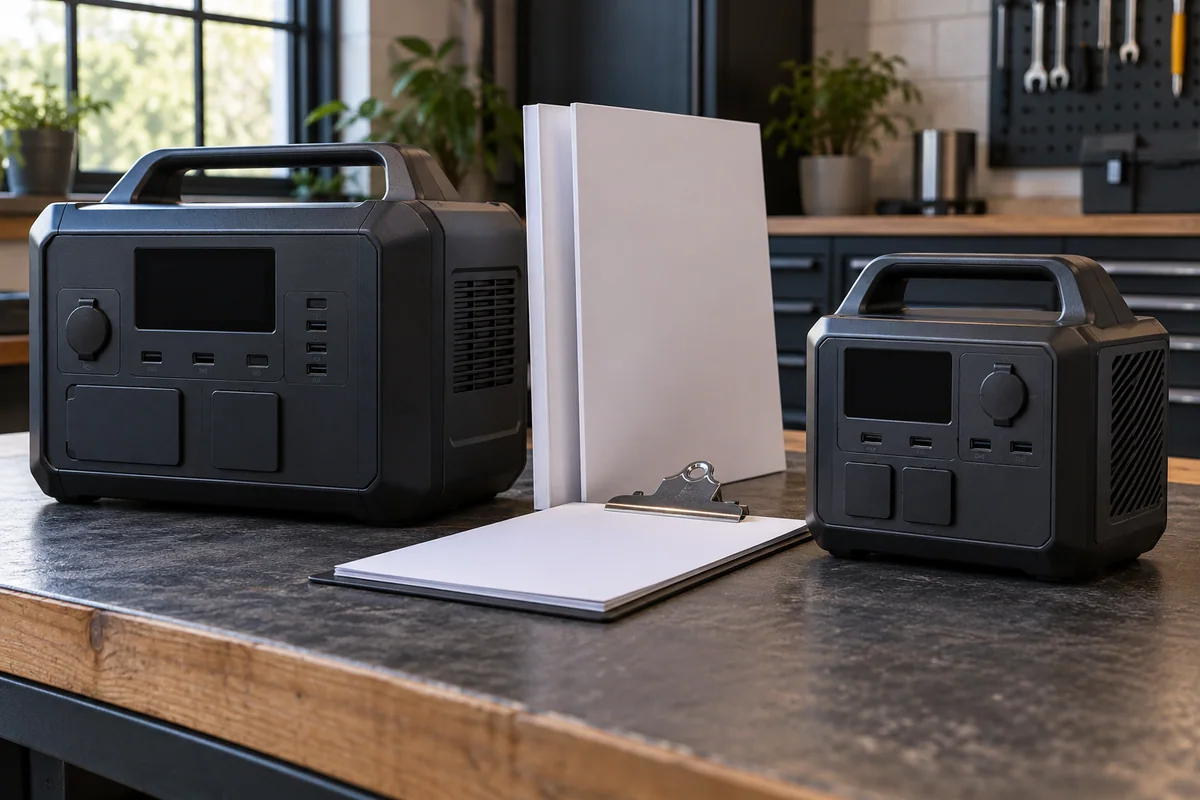
A portable-power RFQ should make suppliers state what each rating measures, under which conditions and for which exact product version. Keep stored energy, output power, input power and claimed operating time in separate rows. A larger headline number is useful only after the units and conditions are understood.
Start with an already approved use description. Give suppliers the equipment models, the loads that must run together, the intended duration and the environment information supplied by the responsible project owner. Ask them to identify missing inputs and support their answers with the exact product’s official documentation. This is a quotation method, not a procedure for sizing, connecting or testing an electrical system.
Separate four questions before comparing figures
Watts describe power; watt-hours describe energy. NIST’s public terminology identifies energy in joules and a watt as a joule per second. That dimensional distinction explains why a number in W cannot be ranked directly against one in Wh. It does not establish how much energy a particular device delivers to a load. NIST energy and power terminology
Ask first for the manufacturer’s stated battery energy and its rating basis. Ask separately for normal rated output, including whether the quoted figure is shared across ports or applies to one port. Then request any time-limited peak claim with duration, applicable load conditions and the document that defines it. Finally, ask for runtime evidence against the buyer’s specified load profile.
Keep charging input in another group. A maximum charging-power statement does not answer an output-power requirement. Likewise, a special operating mode that supports selected loads must retain its stated limitations. Do not move its marketing number into the ordinary rated-output column.
Send a rating-condition table suppliers can complete
Use one table per exact offered model and regional version. Add the quotation date and document revision above it. Where a manual gives no relevant condition, ask the supplier to mark that field unresolved rather than inventing one.
| Requested metric | Required answer | Conditions and scope to identify | Evidence needed |
|---|---|---|---|
| Battery energy | Manufacturer-stated value in Wh | Rated basis, exact model/version, any stated temperature or capacity conditions | Manual/datasheet section and revision |
| Normal AC output | W, voltage and frequency | Combined or per-port limit, operating mode, temperature qualifications | Exact-model output table and notes |
| Time-limited peak output | W and permitted duration | Applicable load type, triggering conditions and any repetition limitation stated | Manufacturer’s definition; unresolved if absent |
| Special output mode | Separate value and mode name | Supported load category and exclusions | Exact instructions, without assuming normal output equivalence |
| Input rating | AC or DC input figure in its own row | Input source, charging mode and relevant conditions | Exact-model input table |
| Claimed runtime | Hours or minutes at the stated load | Load profile, output used, start/end criteria, environment and whether measured or estimated | Test record or clearly identified calculation |
The table requests facts; it does not require every manufacturer to publish every possible field. The supplier can answer “not stated in this document” and identify who can clarify it. That response is more reviewable than a confident figure without a source.
Read the qualifications around an exact-model example
A useful documentation example is BLUETTI’s AC180 User Manual, P/N 17.0303.0531-03A3, reached through its official user-guide page and checked on 13 October 2026. Section 3.2 lists 1,152 Wh battery capacity and 1,800 W total AC output. The same table qualifies discharge operation at 30–40°C with a 1,500 W maximum. Those entries belong together in a quote comparison. AC180 manual, printed page 11
Section 4.1.2 describes Power Lifting for specified resistive loads while saying the rated output remains 1,800 W. Section 4.4 treats operation time as conditional on the load and other factors. The narrow lesson is to preserve qualifications when transcribing figures. We have not tested the device, established supplier availability or approved it for a buyer’s application. Recheck the current manual and exact supplied version before relying on this example for a purchase.
Describe the requested load without guessing a runtime
For each load, provide the equipment identifier and the manufacturer information already available. Say which devices operate simultaneously, whether usage is continuous or intermittent, and which period matters to the buyer. Ask the qualified reviewer what additional information is needed for startup behavior or other application-specific demands.
State whether the requirement concerns isolated portable use or another system context. Do not assume a product can be connected to a building, another source or safety-critical equipment merely because its output figure looks sufficient. Leave integration and permitted-use decisions with the responsible qualified person and the manufacturer’s instructions.
When a supplier gives an operating-time estimate, request its assumptions in writing. Was the figure measured with the stated equipment, calculated from an assumed load, or copied from a marketing example? Does it cover the buyer’s temperature and operating pattern? Do not convert an unsupported estimate into a guarantee by putting it in a spreadsheet.
A fictional comparison with two different gaps
Suppose fictional Offer A names Model P-A and states 1,000 Wh, followed by “up to eight hours.” It supplies no load or runtime calculation. Fictional Offer B names Model P-B and states 800 W normal output and 1,600 W peak, but provides no peak duration. These identifiers and numbers are invented to illustrate incomplete replies; they are not market offers or recommended ratings.
For A, copy 1,000 Wh only into the stated-energy row and mark its evidence status. Put the eight-hour claim in a separate unresolved runtime row. Ask for the actual load, conditions and evidence. Do not derive an assumed appliance wattage from the slogan and treat it as a specification.
For B, preserve the distinction between 800 W and 1,600 W. Request the exact manual and peak definition. Neither offer can be ranked for the buyer’s operating-time requirement yet. One is missing the basis for runtime; the other is missing the meaning of a time-limited output claim. The decision is to obtain the missing evidence, not to manufacture a winner.
Hold only what the evidence does not establish
Use a small question log: buyer requirement, supplier answer, document location, missing condition, responsible reviewer and next decision. Mark an unsupported figure as unverified; mark two documented but differently conditioned figures as not yet comparable. These statuses explain the problem more accurately than labeling a product good or bad.
Hold the relevant selection when the model is unclear, input and output figures are mixed, a peak claim lacks needed conditions, or the proposed operating mode differs from the approved requirement. A product may be fully documented and still fail the buyer’s needs. Conversely, missing documentation is an evidence gap rather than proof of a defect.
Before requesting a revised price, return the completed table and ask the supplier to confirm the same model, version and assumptions. Keep any alternative in its own record. A comparable RFQ ends with documented ratings and named unresolved decisions, while performance approval remains with the people qualified to make it.
Frequently asked questions
Is a Wh figure enough to promise operating time?
No. Ask for runtime evidence against the stated load and conditions. Keep estimates separate from measured results and from any actual contractual performance commitment.
Can peak output replace a normal rated-output requirement?
Do not assume that. Request the manufacturer’s peak definition, duration and limitations, and have the responsible reviewer assess it against the approved use.
Why record the regional version?
The exact version determines which official specification applies. Preserve the manufacturer’s model and regional identifiers instead of combining values from different versions.
What if a manual omits a condition the project needs?
Mark it unresolved, ask for manufacturer clarification and hold that part of the selection. Do not fill the gap with a generic efficiency, duration or temperature assumption.
Sources
Discuss a sourcing request related to this article.Ask for Comparable Power and Energy Ratings in a Portable-Power RFQ