
Ask Whether MOQ and Price Tiers Apply per Variant or per Order
Use a variant quantity grid to confirm MOQ, selling units and price-tier eligibility, then re-quote changes without silently adding unwanted stock.
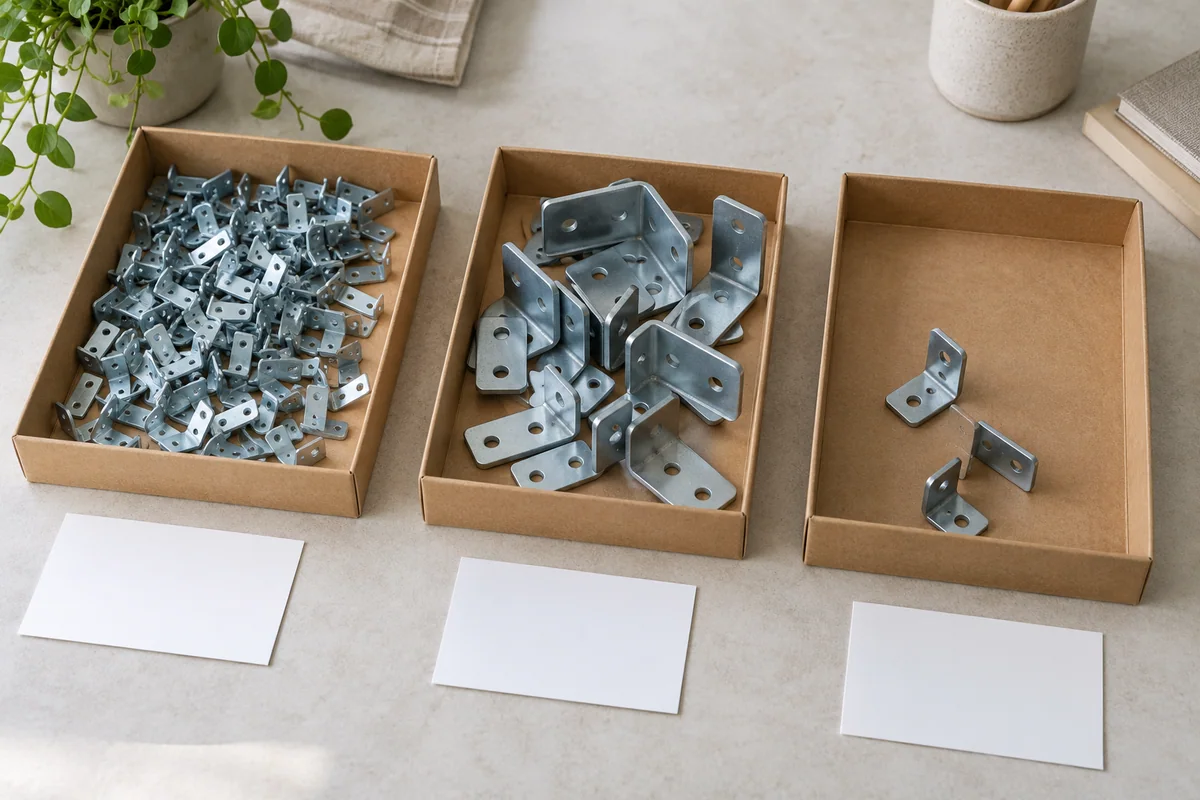
Send suppliers the exact variant mix you need and ask them to state how their minimum quantity and price tiers apply to that mix. “Twenty pieces” is incomplete when the order contains different sizes, finishes or selling units. A total can satisfy one quoted condition while leaving a variant-level condition unresolved.
The useful output is a scenario grid: one fixed need, one supplier response for each variant, and a clear statement of whether the offered quantity rule permits that scenario. Keep the original need visible when a seller proposes more stock. This article focuses on quote applicability and revisions, rather than freight optimization or pack-rounding landed-cost calculations.
Define a need before negotiating a tier
Write the quantity needed for each exact variant and the unit in which that need is expressed. Use existing product references so suppliers can connect the quantity to the correct size, material and finish. Keep this grid separate from the master product description rather than creating a second naming system.
State whether the quantities are fixed or whether a bounded alternative is welcome. If the buyer will consider extra units, record the maximum acceptable amount for each variant. Do not let an unstated willingness to buy more become permission to change the assortment.
Include the required purchasing scenario: stock version, custom version or another clearly described option. Ask each supplier to identify the scenario it actually quoted. A reply about an available stock mix does not answer an RFQ for selected custom variants just because the order total is the same.
Ask for three different quantity rules
First, ask about the minimum: the smallest eligible purchase for the particular offer. Request its unit and aggregation basis. Does it apply to each size, each finish, one listed product family, a fixed assortment, or the complete quoted order? Leave the answer unconfirmed until the seller states it for your selected variants.
Second, ask about the selling unit or order increment. If a price applies to a pair or pack, ask how many individual pieces it contains and whether the contents are fixed. A seller can describe a unit clearly while leaving the minimum unclear; keep both fields.
Third, ask how the price tier is selected. Which quantities count together? Does the stated tier require the exact submitted mix, a particular total, or another condition? Ask whether one tier price applies to every variant or whether each variant retains its own quoted amount. Do not assume that meeting a minimum also secures the lowest displayed price.
These are questions for a dated seller response, not claims of a platform-wide 1688 rule. No actual seller policy, available price or minimum has been established by this article.
Build the response grid
Send the request columns already completed and ask the supplier to fill the rest. Preserve an unanswered cell as “unconfirmed” rather than copying a nearby answer across all variants.
| Field | Buyer input or requested response | Why it matters |
|---|---|---|
| Scenario and revision | Exact mix, issue date and reference | Prevents a reply to an earlier mix being reused |
| Variant reference | Selected size/finish and product reference | Identifies which units count |
| Needed quantity | Individual pieces or explicitly defined sets | Keeps actual demand separate from offered stock |
| Selling unit | Piece, pair or pack, with contents | Makes quote quantities readable |
| Minimum basis | Supplier’s exact rule and unit | Shows whether the requested mix qualifies |
| Tier aggregation | Which variants may count together | Prevents an assumed mixed-quantity discount |
| Offered quantities | Quantity for each variant and total | Exposes extra stock or changed assortment |
| Applicable price basis | Currency, unit and tier reference | Connects the price to this scenario only |
| Confirmation and validity | Dated reply, quote ID and conditions | Shows what must be reconfirmed |
| Decision | Confirmed fit, alternate quantity or clarification needed | Avoids an automatic price ranking |
Keep the seller’s original terminology beside any translation. If a reply uses “set,” ask for its component quantities. Do not normalize an ambiguous term into “piece” simply because that makes the comparison easier to calculate.
A hypothetical 12-small, 8-large request
Suppose a buyer needs 12 small and 8 large passive organizer brackets, all individually counted. The total is 20 pieces. Every supplier and quantity rule below is invented solely to show the grid; no 1688 listing or commercial offer is represented.
| Fictional response | Stated minimum and aggregation | Result for 12 small plus 8 large | Next action |
|---|---|---|---|
| A | 20 pieces total; these two sizes may mix | Quantity condition met in this example | Request the applicable price for this exact mix |
| B | 10 pieces of each selected size | Large variant does not meet that condition | Request a distinct alternative or decline the extra stock |
| C | “20 minimum”; no unit or mix basis | Unconfirmed | Ask what the 20 counts and whether sizes may mix |
A has answered the quantity question but has not yet supplied a price in this example. Do not invent a price tier to complete the row. B’s response does not automatically authorize the buyer to increase the large variant. C’s apparently matching number does not establish eligibility.
If B offers 12 small plus 10 large, save that as a separate 22-piece alternative with two extra large brackets. The alternative may be acceptable, but it answers a changed purchasing quantity. This is a count comparison only; no landed cost, savings or future use is assumed.
Re-quote changes even when the total stays the same
Now change the hypothetical need to 8 small and 12 large. The total remains 20, but the variant-level position has changed. Under B’s invented rule, the small variant is now short of its minimum. Under A’s invented rule, the total condition still appears satisfied, but the applicable prices for the revised mix must still be confirmed.
Issue a new scenario revision and ask each supplier to state which conditions remain valid. Preserve the prior response for comparison; do not overwrite it or assume a previous total price follows the new assortment. A change in finish or custom requirement deserves the same treatment even if quantities remain unchanged.
When several scenarios are useful, give each a clear purpose: the exact need, a buyer-authorized higher quantity, or an acceptable fixed assortment. Ask for separate answers rather than a blended “best price” that does not identify what can actually be ordered.
Decide without disguising surplus
Mark a scenario ready for product-price comparison only when the selling unit, offered quantities, minimum basis and applicable tier are explicit. Keep the amount of extra stock visible beside any lower unit price. The buyer’s willingness to hold that stock is a separate decision from the supplier’s eligibility rule.
Hold a comparison when the reply combines variants without permission, quotes a different selling unit, omits pack contents, or leaves the tier basis unexplained. If the required quantity cannot be quoted, ask for an acceptable alternative and compare it honestly with another source. More stock is not automatically the next best step.
The next request can be direct: “Please return this quantity grid for the exact mix shown. State the minimum, selling unit, variants counted toward the tier and price basis. List any extra-quantity proposal separately, and identify which answers change if the mix is revised.”
Frequently asked questions
Can different sizes or colors share one MOQ?
Only the actual seller response can establish that for the selected offer. Ask which variants may count together and retain the dated answer with the quote.
Does a total of 20 pieces satisfy a 20-piece minimum?
It depends on what the seller counts and whether the minimum applies per variant or across the stated mix. An unclear basis remains unconfirmed.
Do I need a new quote if only the mix changes?
Request written confirmation for the revised scenario. An unchanged total does not establish unchanged variant eligibility or prices.
Should I increase quantities to reach a lower tier?
Treat the higher quantity as a separate, authorized alternative. Keep surplus by variant visible and compare it with the actual need rather than assuming extra inventory has value.
Sources
- Existing sourcingagent guides, supplied full-content snapshotSourcingagent repository; supplied authoring snapshot
- Existing public English RFQ worksheet, supplied snapshotSourcingagent repository; supplied authoring snapshot
- Accepted private shipping English articles, supplied snapshotSourcingagent repository; supplied authoring snapshot
Discuss a sourcing request related to this article.Ask Whether MOQ and Price Tiers Apply per Variant or per Order