
Define What Belongs in One Sellable DIY Kit
Define one complete passive DIY kit with a package-level contents tree, explicit exclusions and quantities tied to the correct parent container.
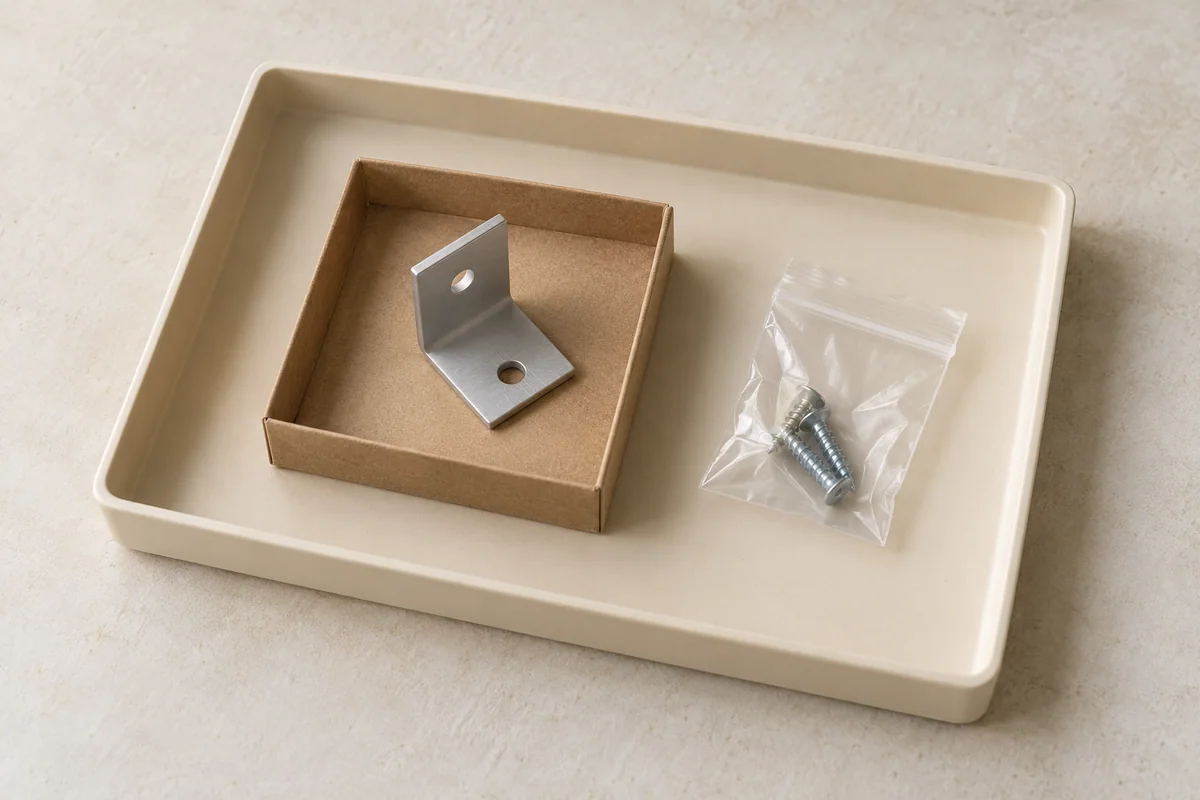
Define one sellable kit before deciding which containers will hold it. Name the approved kit version, list every included component and assign each item to a specific package level. A buyer should be able to point to one consumer package and explain exactly what belongs inside it, without borrowing an accessory from the surrounding carton.
The practical deliverable is a contents tree: a parent package, its immediate contents and the references that authorize those relationships. This article supplies a planning method for passive DIY parts. No actual order, approved kit bill of materials or packing specification was supplied; the example is fictional.
Start with the approved commercial unit
Retrieve the accepted contents list and define what the customer buys as one unit. Record its kit identifier, version, component references, quantities and explicit exclusions. Keep alternate versions separate even when their outer packaging looks identical. A photograph of a bracket beside several accessories cannot decide which accessories belong to the sale.
Resolve ambiguous selling units before drawing the tree. One kit, one pair and one pouch are different units. If an order names a pouch without defining its contents, the pouch can be represented as an unresolved group; its internal piece total remains unknown. Do not fill that gap using another seller’s photograph or a customary quantity.
Also identify the person authorized to decide membership. The buyer’s product owner approves what the customer receives. The packaging owner proposes how those approved contents are arranged. A packing provider can explain an execution problem, but should not quietly remove a component or add a substitute to solve it.
Keep product membership and packaging membership connected
Use the product contents list to describe the supplied goods. Use a linked packaging bill of materials to describe the pouch, tray, divider, insert and other approved packing items. The two records should agree without counting the same physical object twice. A reusable organizer may itself be a purchased product deliverable; a temporary tray may be packaging only. Have the buyer state the intended role.
Give each physical package level a clear name. For this worksheet, the consumer kit is the unit passed to its recipient; an inner group holds a stated number of those kits; a transport container holds stated inner groups or kits. These are working definitions for the project, not a required universal hierarchy. Omit an inner level when the approved arrangement does not use one.
Identifier roles deserve the same care. GS1’s architecture distinguishes trade-item identifiers from identifiers for logistic units. That supports keeping a product identity separate from a transport-container identity; it does not require this kit to use GS1 codes or make an internal pouch a separately traded item. GS1 System Architecture, Table 4-1
Build the package-level contents tree
For every parent, list only its immediate children. Put the contents of a child pouch on a separate row beneath that pouch. State the quantity relative to its named parent, rather than leaving the reader to guess whether a number means per kit, per inner group or per carton.
| Parent level | Immediate contents | Quantity basis | Approval reference and owner | Explicit exclusion or open point |
|---|---|---|---|---|
| Consumer kit | Approved parts, component pouches and recipient insert | Per one sellable kit | Kit contents revision; buyer product owner | Optional variants and separately sold items |
| Component pouch | Exact passive component references | Per one named pouch | Contents schedule; buyer product owner | Spare role or unresolved inner quantity |
| Inner group, if used | Identified complete consumer kits | Per one inner group | Packing layout; packaging owner | No assumed shared consumer accessory |
| Transport container | Named inner groups or complete kits | Per one container | Approved packing configuration; packaging owner | Protection performance separately unresolved |
| Packaging items | Tray, separators and other specified materials | At the level where used | Packaging materials list; packaging owner | Product membership does not approve material suitability |
Include a source, issue date and approval status for each relationship in the working file. A proposed arrangement can be useful before approval, provided the record visibly says proposed. A supplier’s acknowledgement of receipt is a different event from buyer approval of contents or provider confirmation that it can execute the packing arrangement.
Test the tree with a fictional kit
Assume fictional kit K-17 revision C contains one passive bracket, one pouch P-4 and one instruction insert I-C. P-4 contains four approved screws. The assumed packing plan groups two complete kits in one inner package and three inner packages in one transport container. None of these references or quantities describes an actual order.
The planned hierarchy yields 3 × 2 = 6 consumer kits per transport container. It therefore calls for six brackets, six P-4 pouches, twenty-four screws within those pouches and six recipient inserts. The six pouches and twenty-four screws are two levels of description of the same contents; adding them together as thirty supplied components would confuse containers with their contents.
Now consider a proposed layout with six brackets in individual trays but one shared pouch holding all twenty-four screws. Its total screw quantity matches the arithmetic, yet it no longer represents the approved consumer kit. Someone would have to allocate the screws before each recipient receives a complete kit. Ask the buyer to approve a changed membership arrangement or ask the packaging owner to restore one P-4 pouch per kit. A correct container total cannot resolve that decision.
Resolve loose, shared and excluded items
Give every loose item an owner and destination. If an instruction insert belongs to each recipient, placing one copy in the transport container does not satisfy that fictional per-kit definition. If a document is intended only for the receiving business, record it at that separate level. Document placement should follow its approved purpose.
Shared accessories require an explicit allocation decision. Record which kits depend on them and who will separate them before handover. If the intended sales process has no such step, the proposed shared arrangement remains incomplete. Do not rely on the eventual recipient to discover how the buyer meant to divide the contents.
Keep exclusions visible where confusion is likely. A pictured display base, optional finish variant or separately purchased tool should not appear as an unexplained missing child. Use the buyer-approved wording rather than inventing commercial promises or assembly requirements.
Freeze the membership decision narrowly
Close the tree when every active component has one intended home, quantities use named parent units, and open membership questions have an authorized answer. Record the approved kit version alongside the packing version. If either changes, review the affected relationships instead of silently carrying forward the old tree.
The resulting record defines planned contents and allocation. It does not establish that goods were actually packed, verify a received quantity or demonstrate transport protection. Those later decisions need their own evidence. The immediate gain is a clear handover: each party can identify one complete consumer kit and distinguish it from the larger containers around it.
Frequently asked questions
What is the difference between one kit and an inner package?
The kit is the buyer-defined consumer deliverable. An inner package is a named grouping of those kits when the approved arrangement uses one. State quantities relative to each parent so the two units cannot be confused.
Can one shared accessory pouch serve several consumer kits?
Only under an explicitly approved allocation arrangement. Identify which kits depend on it and who separates the contents before handover. Matching the transport-container total does not establish complete individual kits.
Does the product contents list replace the packaging bill of materials?
No. Keep the approved goods and their quantities linked to the pouches, trays and other packing items. State when an organizer is itself a purchased product so it is not classified or counted twice.
Does an approved contents tree demonstrate transport protection?
No. It defines planned membership and allocation. Physical packing completion, receiving counts, material suitability and protection performance require separate evidence and decisions.
Sources
Discuss a sourcing request related to this article.Define What Belongs in One Sellable DIY Kit