
Ship battery products and accessories together or separately?
Split battery products and accessories only when both proposed shipments are accurately described, accepted for their complete routes, and cheaper or operationally better after duplicated costs. A lower ordinary-cargo rate for accessories does not automatically outweigh a second collection, minimum charge, clearance or receiving event.
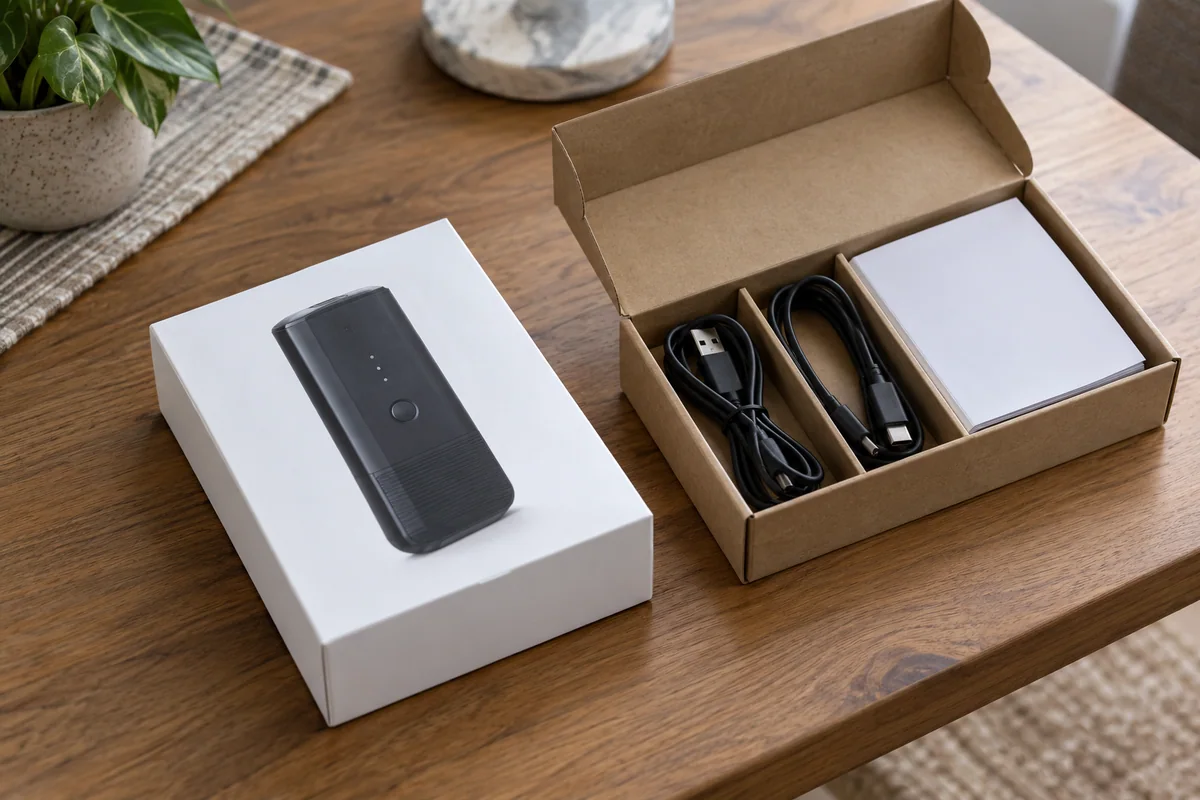
Split battery products and accessories only when both proposed shipments are accurately described, accepted for their complete routes, and cheaper or operationally better after duplicated costs. A lower ordinary-cargo rate for accessories does not automatically outweigh a second collection, minimum charge, clearance or receiving event.
First clarify what “split” means. Sending non-battery accessories separately from intact products is a logistics comparison. Removing batteries from products changes the shipment configuration and requires fresh specialist assessment. Do not dismantle products or alter electrical assemblies to pursue a freight saving.
Gate one: establish what can actually travel
Give a qualified dangerous-goods specialist a model-level goods list, battery chemistry and rating, configuration, condition, quantities and proposed route. Ask for the classification, applicable transport requirements and carrier acceptance for each option. Missing technical documentation is a stop point, not a reason to use a generic description.
For air cargo, IATA’s 2026 battery guidance distinguishes batteries alone, packed with equipment and contained in equipment. Its FAQ D.05 specifically says loose lithium-ion batteries with only cables or an AC adaptor remain UN 3480; those accessories do not make them batteries packed with equipment. The guidance also states that an operator need not carry a shipment merely because a State-of-Origin approval exists. It is guidance, not a replacement for the applicable rules or a shipment-specific compliance decision.
Never split a consignment to conceal batteries, evade a package or consignment limit, omit required declarations or bypass carrier approval. Every package and consignment must be assessed as actually offered. Sea or road alternatives need their own applicable review; an air assessment does not approve another mode.
Gate two: compare complete operational options
Describe the alternatives without assuming either will be accepted:
- Combined: approved battery products and compatible accessories move under one defined logistics plan
- Separate: the intact battery products move through their approved plan; clearly identified non-battery accessories use another accepted plan
- Staged: eligible goods move when ready and the remainder follows, with receiving and assembly implications priced separately
The specialist and provider may reject an option. Remove it from the cost ranking rather than assigning it a tempting hypothetical rate. Also confirm that the accessory shipment contains no overlooked batteries, battery-powered promotional items or other goods requiring special handling.
For each feasible option, request a packed configuration, chargeable quantity, transport price, applicable special-service charges and exclusions. Add collection, documentation, origin handling, destination services, insurance if selected, and final delivery. Ask which charges apply per shipment rather than per kilogram.
A cost worksheet that catches false savings
Use this comparison: combined total minus split total equals the potential saving from splitting. Both totals must cover the same required outcome. If split receiving leaves products unusable until a later accessory arrival, that is a service difference to assess, not a saving to hide.
Hypothetical example, with invented USD amounts and no implied market rates:
The combined option is USD 1,200 for the accepted transport scope plus USD 100 for receiving, totaling USD 1,300.
The split option is USD 850 for the battery-product shipment, USD 180 for the accessory shipment, USD 160 of extra duplicated collection and document services, and USD 150 for two receiving events. Its total is USD 1,340.
The accessory freight looks inexpensive, but splitting costs USD 40 more. Both options here exclude product cost, duties and taxes, insurance and any disruption cost. These exclusions must be checked before a real purchasing decision.
A sensitivity check makes the trade-off clearer. If extra duplicate services were USD 60 instead of USD 160, the split total would be USD 1,240, saving USD 60. That saving is the maximum room left for any additional kitting or delay cost before the split loses its price advantage. It is not a prediction that such extra costs will occur.
Price the receiving problem before dispatch
Ask the destination team whether the goods can be received independently. A kit may require a cable, bracket, manual or other accessory before it is ready for sale or use. Identify who matches the separate deliveries and who checks missing quantities.
Use a common purchase-order reference and distinct packing records. Set a receiving reconciliation process that records which products and accessories arrived without falsely representing them as one physical shipment. Have the broker or logistics provider confirm the appropriate shipment documentation and customs treatment.
Do not invent a cash value for a delay just to complete a spreadsheet. If the buyer can substantiate a rework or storage cost, show it separately with the assumption. If not, record the operational consequence in words: “goods cannot be released until both deliveries arrive.” That can still be decisive.
When combining deserves priority
Combining may be preferable when accepted packaging is already established, accessories are small relative to the shipment, the receiver needs complete kits, or duplicate charges consume the possible saving. These are decision criteria to test against quotations, not promises that consolidation is always cheaper.
Splitting may be worth quoting when accessories account for substantial ordinary-cargo volume, have an independent use, or are ready on a different schedule. The saving must survive the full comparison and the route-specific acceptance review.
Pause if the proposal relies on relabeling a battery product as an accessory, using an unrelated test document, or treating carrier silence as approval. Request corrected documentation and an explicit accepted plan.
Before booking, give the sourcing team a simple brief: price both feasible configurations from the same SKU list, disclose every battery, and show duplicate charges and receiving consequences separately. Choose the lower-risk usable outcome, with cost measured only after compliance is established.
Frequently asked questions
Can I put loose batteries with cables to get an equipment classification?
No. IATA 2026 FAQ D.05 says cables or an AC adaptor alone do not make loose lithium-ion batteries packed with equipment. Obtain qualified classification of the actual goods.
Does splitting always reduce battery freight charges?
No. The battery shipment still needs its appropriate assessment, and the second shipment can add minimums and handling costs. Compare accepted complete offers.
Should I remove installed batteries to save shipping cost?
Do not modify or dismantle products for this comparison. Any changed configuration needs qualified safety and transport assessment and may make the logistics plan less suitable.
Can the accessories arrive first?
That can be an option if the route and goods are accepted and the receiver can use or store them independently. Price separate receiving and reconciliation before choosing it.
Sources
Discuss a sourcing request related to this article.Ship battery products and accessories together or separately?