
Quote the Exact Mating Connector, Not a Similar-Looking Plug
Make a connector RFQ identify exact mating parts, housings, contacts, accessories and evidence, with compatibility owned by a qualified reviewer.
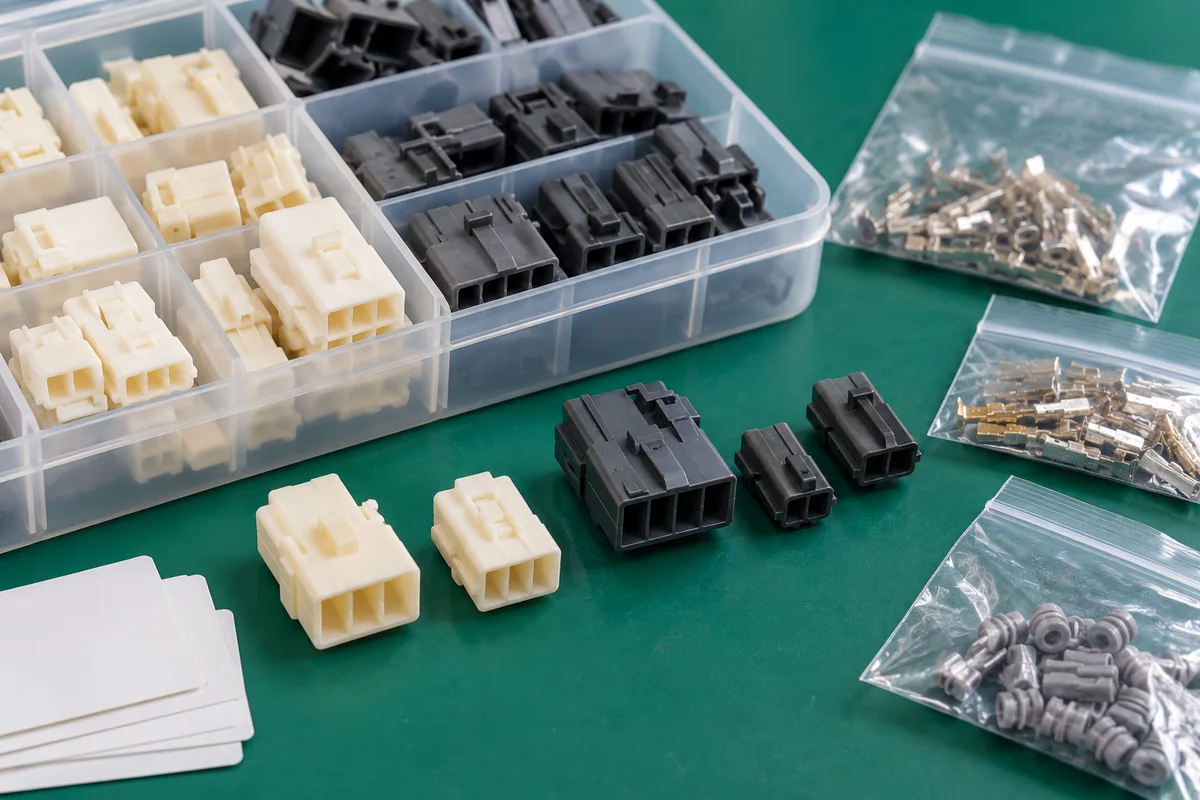
A connector RFQ should identify the exact manufacturer-declared mating relationship and every part needed in the quoted supply. Start with the approved interface and the full part number on each side. A matching outline, shared pitch or familiar series name leaves too much unresolved to authorize a purchase.
The buyer’s responsible engineer or other qualified project owner must define the required interface. This article organizes the supplier’s answer for passive connector housings and specified accessories. It does not assign pins, select wiring, explain crimping or authorize mating and energizing equipment.
Begin with the interface that already has authority
Record the existing equipment or assembly reference, the manufacturer’s connector part number, the relevant drawing and its revision. Ask the project owner to confirm which side is needed and whether the request is for a housing, contacts, accessories or a finished assembly. Retain the manufacturer’s names for plug, receptacle, pin and socket rather than guessing from the exterior.
If the existing part is unidentified, make identification the first task. Request appropriate manufacturer evidence through the responsible owner. A supplier’s photograph can help explain what it is offering, but it cannot independently establish the mating relationship or the permissible electrical use.
Ask the seller to quote the specified manufacturer part or identify a proposed substitute explicitly. “Compatible connector” without exact identifiers is an unanswered offer. Keep any substitute in a separate record so it cannot inherit approval intended for the named part.
Separate identity from supplied contents
A housing reference should not silently stand for a complete connection. Ask which contacts, seals, locks, backshells or other accessories the approved configuration calls for, and which are included in the seller’s quote. Some items may be inapplicable; mark them that way based on the approved requirement rather than populating a universal kit list.
Count each quoted deliverable in its own unit. A bag of ten housings, a strip of contacts and ten assembled leads are different supplies. If a seller uses a bundled kit code, request the controlled contents list and its revision. A marketing photograph of several pieces does not settle what is included in one purchasable pack.
Use this matrix with the quote reference and issue date above it:
| Identity or scope field | Required RFQ entry | Supplier evidence or response |
|---|---|---|
| Buyer interface ID | Approved equipment/assembly and required side | Repeat the buyer ID in the quote |
| Existing mating part | Manufacturer and full exact part number | Official mating reference, not shape comparison |
| Offered housing/header | Manufacturer, series, full suffix and quantity/unit | Exact product page and drawing revision |
| Contacts | Approved contact part IDs and required quantities | State included, separately quoted or unresolved |
| Accessories | Required part IDs for the approved configuration | State contents and pack quantities, or justified not applicable |
| Mechanical identity | Manufacturer’s polarization/keying and position information | Applicable drawings and relevant notes |
| Rating basis | Exact documented configuration and conditions | Document reference for qualified review |
| Approval owner | Person responsible for compatibility and any alternatives | Written disposition; outstanding questions retained |
Read the mating statement with its qualifications
A bounded documentation example comes from TE Connectivity. Its current public product pages identify 1-480704-0 as a Universal MATE-N-LOK plug housing and 350762-4 as a PCB socket-header assembly, with separate exact-part drawings. The reviewed plug drawing is 480704 revision AT; the header drawing is 350762 revision N2. Those are document observations, not a recommendation for the reader’s equipment. TE housing and drawing entry and TE header and drawing entry
The manufacturer-served Catalog 82181, page 183, lists 350762-4 with plug housing 1-480704-0 under a mating column qualified by pin contacts. That page is marked Revised 4-08. It is used here as a historical example of how a mating reference carries a contact qualification, not as current authorization to order or assemble the pair. Current applicability, exact contact selection and the buyer’s interface require manufacturer and qualified project review. TE catalog, page 183
This distinction matters when transferring data into an RFQ: preserve the qualifying words beside the part numbers. Do not copy a housing’s headline rating into a claim about an arbitrary assembled connection. Request the relevant specification and have the qualified reviewer determine which conditions apply to the approved combination.
A fictional quote that supplies housings only
Assume an approved purchasing list calls for ten fictional H-A housings, twenty specified C-A contacts and ten specified L-A locks. These quantities belong only to this invented example. They do not express a universal contact or accessory count, and the identifiers do not name real products.
The supplier replies “H-A, quantity ten” and shows a photograph containing a housing and several loose pieces. The quoted housing quantity matches the requested housing line. The contacts and locks remain unquoted until the supplier confirms their exact part numbers, quantities and inclusion. Do not treat the photograph as a complete kit bill of materials.
Ask for a revised response with three separate lines or one bundle whose controlled contents match the request. If the supplier proposes C-B instead of C-A, retain C-B as an alternative for qualified review. A claim that it “fits H-A” does not by itself answer the approved interface requirement.
The bounded outcome is a scope hold on the missing or changed items. There is no performed assembly, successful compatibility test or supplier order in this example. The useful action is to obtain a complete, traceable quotation before anyone makes a technical acceptance decision.
Check descriptions that can conceal a substitution
Compare full suffixes, materials or finishes where specified, packaging identifiers and document revisions. Ask the manufacturer or qualified owner to explain meaningful differences rather than deleting punctuation or trailing characters to make two codes match. Keep the seller’s ordering code separate from the manufacturer’s identifier when they differ.
Request both the stated mating relationship and the configuration evidence. A series-level brochure may identify the family while leaving the exact keyed variant or contact unresolved. If a manufacturer offers a compatibility selector, retain its exact result and date; a search result for similar products is not the same as an approved mate.
For rating questions, request the applicable manufacturer’s specification rather than inventing a current, voltage or temperature limit from appearance. Have the responsible reviewer assess any wire, contact, loading or environmental conditions that the document makes relevant. The buyer’s worksheet should record that assessment, not replace it with a generic safety margin.
Release a complete part identity, not an attractive image
Hold the affected line if the mating part is unidentified, a suffix differs without explanation, contacts are omitted, a kit’s contents are undefined or no qualified person owns compatibility. Also hold a supposed exact replacement when the seller has supplied only a family-level picture or a document covering another part.
Close the RFQ with the approved part IDs, quantities, supplied-unit definitions, relevant drawings and any accepted deviations. Keep the approval linked to the exact quote revision. If a supplier changes the housing, contact or accessory later, reopen the affected decision rather than assuming the unchanged appearance preserves compatibility.
A useful final request is simple: repeat our interface ID, quote each specified part and identify anything missing or proposed as an alternative. Ask the appropriate specialist to resolve the remaining technical questions before purchasing. That produces a reviewable supply scope without turning a sourcing conversation into instructions for assembling an electrical connection.
Frequently asked questions
Does a similar-looking plug establish compatibility?
No. Obtain the exact manufacturer-declared mating reference and applicable configuration evidence, then have the responsible qualified owner approve the interface.
Should contacts be quoted separately from housings?
Identify them separately in the requirement even if the seller bundles them. Ask whether the quoted supply includes the exact contact IDs and quantities required by the approved configuration.
Can a historical mating table be used to place an order today?
Treat it as historical documentation until current applicability and the exact configuration are confirmed. The 2008 catalog example in this article is not a current purchase or assembly recommendation.
What if the supplier offers an equivalent part number?
Keep it as a separate alternative with its own documents and deviations. Do not substitute it into the accepted exact-part line without the responsible owner’s review.
Sources
Discuss a sourcing request related to this article.Quote the Exact Mating Connector, Not a Similar-Looking Plug