
Reconcile Received Packs, Pieces and Ordered Quantities
Reconcile packs and pieces using observed counts, agreed pack contents and an explicit unchecked remainder before calling a receipt short or complete.
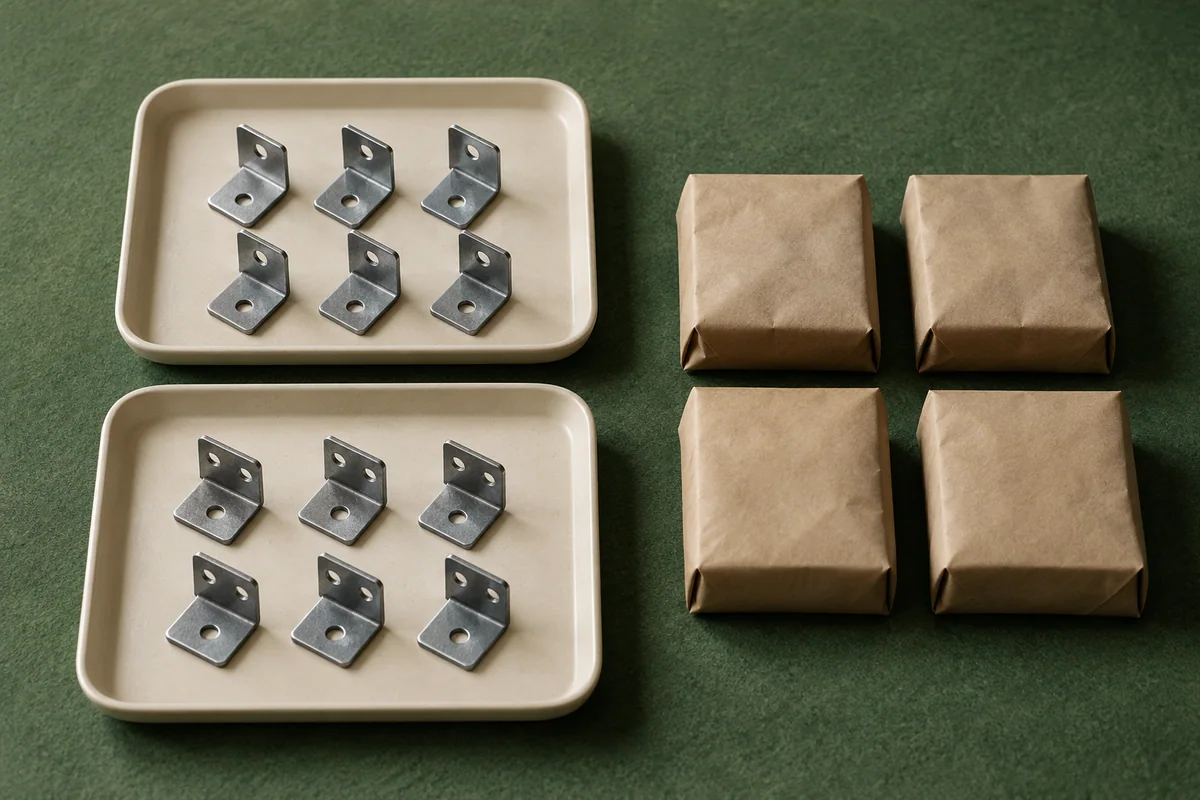
Reconcile received quantities in the unit the order actually uses, and keep counted contents separate from quantities printed on packaging. Six packs received can be a supported package count while the number of pieces inside remains unverified. An apparent shortage should stay an open count question until the relevant receipt scope has been reconciled.
The useful artifact is a quantity sheet with four distinct facts: what was ordered, what the packaging declares, what was physically counted under the agreed safe scope, and what remains unchecked. This article provides a buyer method and fictional examples. It contains no actual receiving count or supplier shortage finding.
Fix the counting unit before calculating a difference
Copy the accepted order line’s quantity, unit and pack definition without rewriting them. “Six packs of four identical brackets” gives both a selling-unit quantity and a stated piece equivalent. “Six sets” supplies no reliable individual-part total until the agreed set contents are identified.
Keep the original-language selling term beside an approved explanation where translation could change the meaning. A supplier may call the purchased item a pack while the receiver calls its outer transport box a carton. Give each level a separate field rather than using “box” for both. If the order itself is ambiguous, request clarification before deciding that the received quantity is wrong.
GS1 US’s packaging definitions distinguish the each, inner pack, case and mixed case. Those distinctions are a useful reminder that packaging levels represent different groupings. They do not establish the contents of a particular delivery or require this worksheet to use GS1 identifiers. GS1 US packaging-level definitions
Record declarations and observations side by side
Use one quantity basis for each column and label it explicitly. The supplier’s packing list, a carton label, a receiver’s package count and a contents count can all be useful, but they answer different questions. Record the source and time of each rather than promoting every number to “received pieces.”
A carton labeled “24” might declare twenty-four pieces, twenty-four packs or another grouping. Preserve the printed wording and resolve the unit. Even an unambiguous piece declaration is still a declaration until the agreed method supports the recorded contents count.
For ordinary passive parts, opening packages and counting contents must remain within the receiving work that was agreed and can be performed safely. A count template does not authorize opening a battery product, exposing components or changing protective packaging. If access is outside scope or unsafe, identify the unchecked portion and refer the decision to the responsible owner.
Use a sheet that shows the unchecked remainder
The following fields are designed to prevent a declared pack size from being mistaken for a measured total.
| Quantity field | Record | Avoid inferring |
|---|---|---|
| Order baseline | Line, revision, ordered quantity and unit | That the latest listing changed the accepted order |
| Agreed composition | Pieces of each specified type per pack or set | That all packs have identical contents without evidence |
| Receipt scope | Exact receipt IDs and package IDs covered | That every expected parcel has arrived |
| Packages observed | Count by packaging level | An automatic piece count |
| Contents examined | Which packages were opened under authorization | That an unspecified sample covered the whole receipt |
| Pieces counted | Actual counts by variant and package | Quantity in unopened packages |
| Unchecked remainder | Identified packages and declared expected contents | Zero quantity or a confirmed shortage |
| Reconciliation | Explained difference, unresolved quantity and next owner | A remedy, refund or lot-acceptance decision |
A report should identify the packages examined, not merely say “two boxes checked.” If packages have no suitable existing IDs, use stable receiving references in the record. Do not relabel the goods physically unless the receiving procedure permits it.
A fictional six-pack receipt
Assume an order for six packs, each stated to contain four identical passive organizer brackets. The agreed receiving scope initially permits counting the six packs and examining the contents of two identified packs. These are invented quantities and actions for illustration, not a recommended sample size.
The receiver records six packs present. Packs P-01 and P-02 each contain four counted brackets. P-03 through P-06 remain closed. The sheet should read:
| Record | Supported result |
|---|---|
| Ordered selling units | Six packs |
| Expected piece equivalent under the agreed composition | Six × four = twenty-four brackets |
| Packs observed | Six |
| Packs with contents counted | P-01 and P-02 |
| Pieces physically counted | Eight |
| Unchecked packages | Four packs, with sixteen pieces expected from their stated composition |
| Quantity conclusion | Package count reconciled; complete piece count not established |
Do not report “twenty-four pieces counted.” Also do not report a sixteen-piece shortage. The sixteen is an expected quantity in unchecked packs, not a finding that sixteen pieces are absent. The two observed packs do not establish that every remaining pack has the same contents.
If the authorized owner needs a full piece count, agree the additional work and safe scope. If the owner makes a limited decision using the existing evidence, preserve its exact scope. Neither choice should change the historical fact that only eight pieces were counted at the initial check.
Diagnose the discrepancy before naming it
Work through plausible record differences without assuming which one occurred. First check the receipt scope: are there declared split deliveries or missing package references? Then check units and composition: was a pack mistaken for a piece, or a set for one component? Finally compare the actual counted entries for duplicate recording or a transcription error.
A revised report should explain the correction. If the receiver counted P-01 twice under different image names, remove the duplicate from the reconciled total while preserving the correction trail. If a supplier says another parcel is still to follow, record that statement and reference. Do not record the parcel as received before it arrives.
Where a count remains inconsistent, request a targeted recount of the identified passive-part scope if authorized. State whether the recount replaces an earlier count of the same pieces or adds newly counted pieces. Adding both results for the same objects would double the receipt. If recounting is unavailable, keep the difference unresolved.
Keep quantity and conformity separate
Suppose, in a continuation of the fictional example, the remaining packs are later counted under an agreed scope and contain fifteen brackets in total. The complete receipt then contains eight plus fifteen, or twenty-three counted brackets against twenty-four expected. Provided all relevant arrivals and the unchanged order baseline have been reconciled, the sheet supports a one-piece quantity discrepancy for that defined receipt.
That conclusion does not identify who caused the difference or establish a replacement entitlement. It also says nothing about whether the twenty-three brackets meet their drawing, finish or material requirements. Report quantity presence and conformity outcomes separately.
If one counted bracket is the wrong variant, retain it in the physical-piece record and flag its variant mismatch. Do not describe it simply as missing; doing so loses evidence that a different object was received. Equally, an extra item of another variant should not offset a shortage on the ordered line without an authorized change to the requirement.
Finish with a bounded count statement
A useful final statement identifies the order revision, receipts covered, units used, packages examined, counted quantities, unchecked remainder and unresolved difference. Attach the relevant count records and identify the person responsible for the next decision. Keep replacement freight, return economics and supplier settlements outside this sheet.
Before relying on the total, check that the same pieces were counted once, every conversion has an agreed composition, and later arrivals have not been assumed. The strongest quantity record is not the one with the fullest-looking number. It is the one that lets another person distinguish what is present, what was declared and what still needs checking.
Frequently asked questions
Can a carton label replace a contents count?
It can support a declared quantity, but it does not become an observed contents count. State the agreed receiving method and retain the unexamined portion.
Are unchecked pieces missing pieces?
No. Keep the expected quantity in unopened or unexamined packages separate from a supported shortage. Reconcile the receipt scope before reporting a missing quantity.
Can two checked packs establish the whole order count?
They establish the results for those packs. Any broader decision needs its own agreed basis; do not label an extrapolated quantity as physically counted.
How should a wrong variant affect the count?
Keep it in the physical-presence record and record the variant discrepancy separately. Do not offset a shortage of the specified variant with a different item without authorization.
Sources
Discuss a sourcing request related to this article.Reconcile Received Packs, Pieces and Ordered Quantities