
Ask for a Packaging Plan Around Passive-Part Protrusions
Prepare a drawing-linked request for packaging around passive-part projections, with permitted contacts and unresolved support assumptions visible.
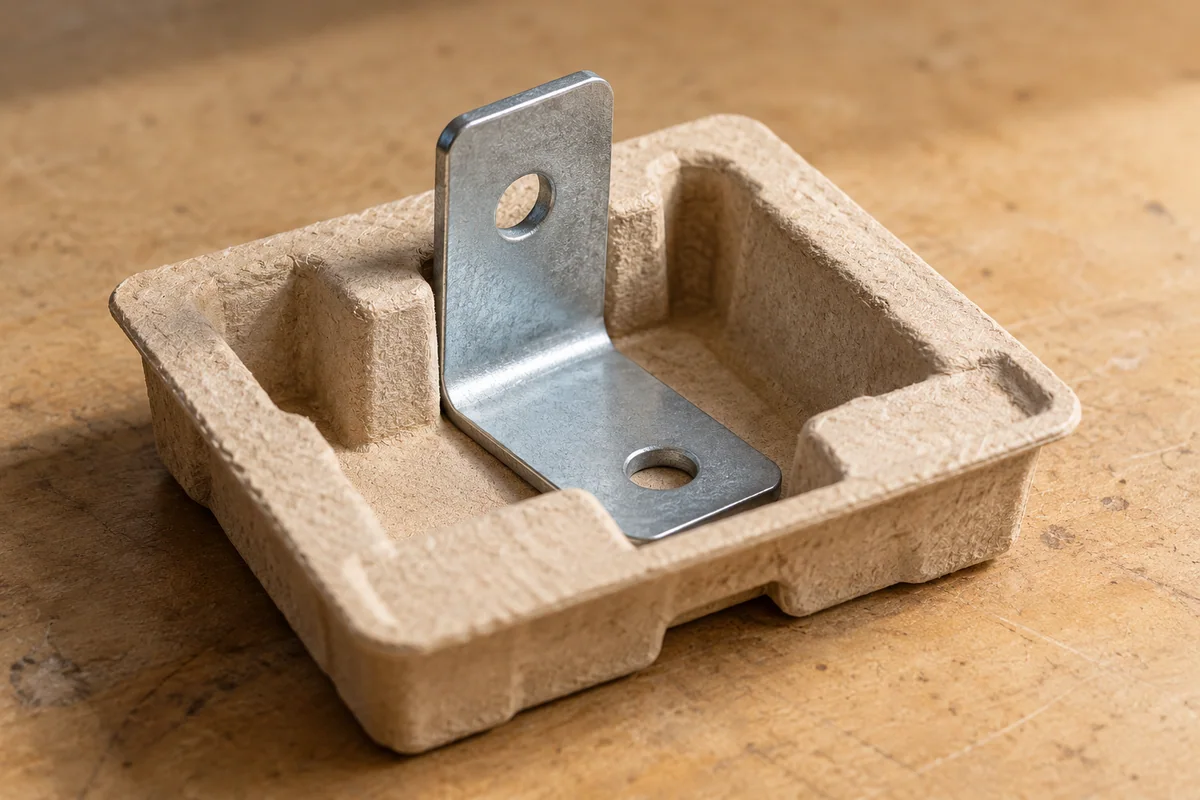
Ask the packaging designer to address each projecting feature on the approved passive-part drawing and show where any proposed guard or support would act. A bracket’s projecting tab should not disappear into a generic instruction to add padding. The buyer needs a reviewable proposal that identifies the feature, neighboring surfaces and unresolved support assumptions.
The deliverable is a feature-to-clearance/guard request drawing with a linked question register. It is a packaging-design brief, not instructions for making a guard. No actual product drawing, load limits, material specification or validation report was supplied. This article covers passive parts only and provides no battery-terminal protection or dangerous-goods packing method.
Identify the feature from the authorized part record
Record the exact part, configuration and drawing revision. Mark each protrusion using a reference that the designer can find in the relevant view. Include the units, orientation and source of any dimensions already authorized for the project. A perspective photograph can help locate a tab; it should not become a source of invented dimensional precision.
Ask whether the drawing covers the part in the state that will actually be packed. A detached accessory, alternate flange or revised bend can change the packaging question. Preserve those configuration differences instead of assuming that one outline represents every variant.
Keep missing dimensions visibly unresolved. The product owner should provide or authorize the geometry needed for the packaging review. Do not estimate a clearance from the empty space in a photograph or choose a guard thickness simply to complete the request sheet.
Describe neighboring features and permitted contacts
Show what sits beside the projection in the proposed package. Identify adjacent parts, finished faces, pouches, inserts and the proposed package closure. Ask the designer to address the relevant relationship: separation from another item, clearance from a closure, or avoidance of contact with a protected face.
Also ask the product owner which regions may support or retain the part. A projection may look convenient as a locating feature while its permitted loading remains unknown. Describe that uncertainty explicitly. The packaging proposal should explain its intended contact locations and identify any product limits it relies on.
Use separate statements for a known requirement and a design question. “No contact with surface S-2” can be a buyer-approved constraint. “Can surface S-3 be used as a support?” remains an open question. An empty space around the tip does not answer how the rest of the part is supported.
Prepare a feature-to-guard request register
Connect each row to an annotated view. The view locates the concern; the register records its authority and the evidence needed to resolve it. Label buyer annotations as such so nobody mistakes them for a revised manufacturer drawing.
| Request field | Buyer input or question | Expected designer response |
|---|---|---|
| Feature reference | Exact part, drawing revision and projecting region | Matching view and proposed orientation |
| Authorized geometry | Existing dimension references, units and unresolved values | Confirmation of the geometry used; questions for missing inputs |
| Adjacent objects | Neighboring parts, package features and protected regions | Proposed separation or relocation shown in the layout |
| Permitted support | Product-owner-approved contact regions and limits, if supplied | Named support locations and any additional assumptions |
| Proposed guard | Functional objective, such as separating a named interface | Identified concept, material reference and design owner |
| Closure and removal | Buyer-stated restrictions or unresolved access questions | Explanation of how the concept addresses the stated scope |
| Validation boundary | Intended conditions and outstanding performance questions | Qualified review plan and evidence required for a decision |
Do not turn the response column into a prescription for cutting, bending or assembling protective materials. The designer should produce the appropriate technical proposal. The buyer’s role here is to make inputs, constraints and unresolved decisions traceable.
Compare concepts by what they leave unanswered
One proposal might locate the part in a formed insert; another might use a separate protective feature around the projection. Describe them as candidate designs until their support locations, materials and conditions have been reviewed. A familiar packaging form is not evidence that it suits this particular geometry.
Ask each proposal to show the projection in relation to its neighbors, including the package in its intended closed state. Request identification of any place where the guard itself touches the product. If a concept relies on a surface carrying force, ask for the responsible owner’s permitted-use basis rather than assuming the surface can tolerate it.
Preserve assumptions in the comparison. A drawing showing nominal separation may leave manufacturing variation, possible movement or package deformation unanswered. Those are questions for the qualified designer and validation owner. This article supplies no minimum gap, load value, thickness or acceptance tolerance.
Work through a fictional projecting-tab decision
Assume a fictional passive organizer bracket BR-T revision C has projecting tab T-1. The buyer’s approved drawing identifies display face S-2 as a no-contact region. A nearby passive plate would sit beside the tab in the proposed kit. No real bracket dimensions or engineering performance are represented.
Concept A shows a cap around T-1, but its rear portion rests on S-2. Concept B shows the bracket in a cradle, with the tab separated from the neighboring plate, but leaves the cradle’s support regions unspecified. Both sketches address the visible tip; they leave different approval problems.
Concept A conflicts with the fictional no-contact requirement as drawn. Return that conflict to the designer with the S-2 reference. Concept B remains a candidate awaiting identified supports and their permitted-contact basis. Do not declare B acceptable merely because the sketch shows more empty space.
Suppose the product owner later approves named support regions S-3 and S-4 for the proposed purpose. The designer can revise B to show those regions and state any remaining assumptions. That would resolve part of the design-input gap, while actual material suitability and protection performance still require their own evidence. A clarified support location is progress, not a completed test.
Give validation its own owner and decision
Agree what the packaging proposal is intended to achieve and which conditions the responsible reviewer must consider. ISTA’s public design guidance emphasizes the intended distribution environment and test objective in selecting an evaluation. This is bounded context for asking the right owner; no specific test procedure has been selected or performed here. ISTA design and testing guidance
When a provider supplies a report, ask the validation owner to confirm which product and packing configuration it covers, what criteria were applied and which questions remain. A report title or photograph of another bracket should not automatically close the register for this one.
Finish the handover with the authorized geometry, protected regions, proposed guard or cradle revision, unresolved assumptions and named decisions. Reopen affected rows if the part, orientation, neighboring contents or protective feature changes. The buyer then has a precise request for a competent packaging review without substituting an improvised guard design for the missing engineering evidence.
Frequently asked questions
What should a buyer provide about a projecting feature?
The exact part and configuration, authorized drawing revision, relevant dimension references, neighboring objects, protected regions and any approved support limits. Mark missing inputs explicitly.
Can an empty gap in a mockup establish adequate clearance?
No. A mockup can communicate a proposed arrangement, but it does not establish an acceptance dimension or resolve variation, movement, support assumptions or protection performance.
Should a guard rest on a convenient nearby surface?
The product owner and packaging designer must establish permitted contacts and support conditions. A surface that looks convenient is not an approved load-bearing or contact region by appearance alone.
Does the brief give instructions for making guards or packing batteries?
No. It requests a qualified packaging proposal for passive parts. It gives no fabrication method, material thickness, load value, battery-terminal guard or dangerous-goods packing advice.
Sources
Discuss a sourcing request related to this article.Ask for a Packaging Plan Around Passive-Part Protrusions