
Define a Reusable Organizer as a Kit Deliverable
Define what a kit organizer should retain and make accessible after unpacking, with explicit limits on closure, material, cleaning and durability claims.
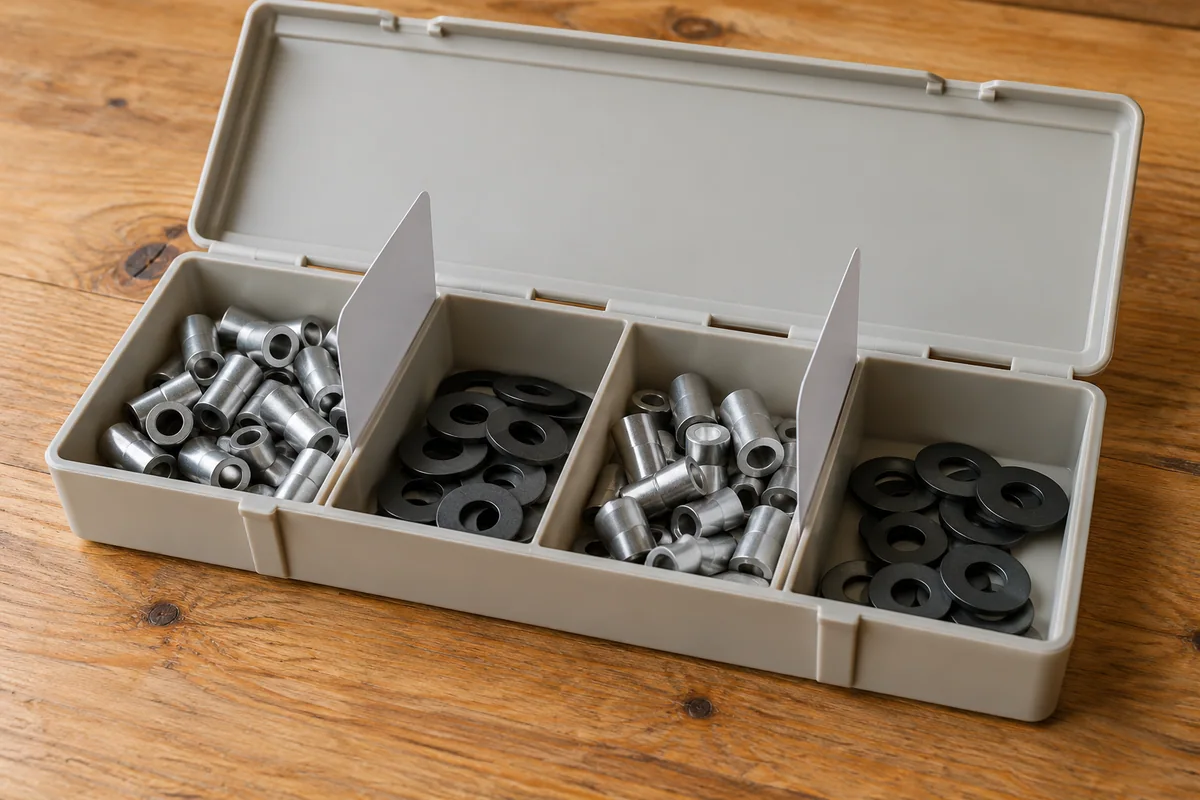
If the buyer expects an organizer to remain useful after unpacking, describe that expected use as part of the deliverable. “Reusable box included” leaves too much undecided: what stays inside, whether parts must remain separated, how the recipient accesses them and which claims need evidence.
Prepare a post-unpacking use brief for the organizer. Begin with approved passive-kit contents and a specific intended use rather than choosing a compartment count from a product photograph. This method does not establish service life, material suitability, environmental benefit or any battery storage function.
Define the state after the kit is opened
Separate the initial presentation state from the later organizer state. Some required kit components leave the container during the buyer-approved use, while specified spare passive parts may remain. A molded insert that displays every initial component may leave awkward empty spaces afterward; a simpler removable-divider arrangement may raise different retention questions. Neither layout is automatically preferable.
Ask what the recipient is expected to keep. List only authorized retained items, with their identities, quantities and any grouping that needs to survive. Distinguish a spare from an unused required component. An organizer brief should not silently reclassify incomplete kit use as a successful outcome or invent extra spare quantities.
State where the intended organizer use stops. A stationary storage arrangement for approved passive hardware is a narrower brief than a container expected to be repeatedly carried between locations. The latter introduces additional questions for the responsible owner. Do not let an image of a handle expand the agreed use.
Give compartments a purpose
Assign each group to an identified location and record why it needs that location. The requirement might be keeping visually similar spacers distinguishable, making a small approved accessory accessible or retaining a reference card with the parts it identifies. A blank compartment is acceptable when its purpose is explicit; unexplained empty capacity should not be promoted as a guaranteed future expansion feature.
Record whether dividers are fixed, removable or still undecided. If a divider can be rearranged, ask how the intended grouping remains clear. If the recipient is expected to keep a pouch inside a compartment, include that pouch in the approved retained configuration. The compartment should not be evaluated as though it contains only loose components.
Access expectations also need a defined user and action. “Easy to use” is difficult to approve. A narrower question is whether the intended recipient can identify the retained spacer group and retrieve it in the agreed mockup review. Have the responsible owner decide any necessary usability evidence; do not invent force limits or claim accessibility for all users.
Build the organizer use brief
Use the following fields as a buyer planning document. They are proposed questions, not a standard or a promise about a supplier’s organizer.
| Brief field | What to state | Evidence or decision still needed |
|---|---|---|
| Retained contents | Exact passive-part groups and approved quantities | Current kit contents and spare designation |
| Post-unpacking state | What is removed and what remains | Buyer-approved use scenario |
| Compartment assignment | Location for each retained group and any pouch | Identified layout or representative mockup |
| Identification and access | How the recipient distinguishes and reaches groups | Agreed review method and observations |
| Closure expectation | What the closed organizer is expected to retain under stated use | Appropriate owner-defined evidence |
| Contact surfaces and materials | Exact interfaces and material identities | Applicable supplier data and compatibility review |
| Repeated use | Which repeated actions matter and what claim is proposed | Defined evidence scope before any durability promise |
| Care limits | Only approved care information for this exact item | Manufacturer guidance, if available; otherwise unresolved |
If any field is unanswered, name the decision owner. A blank field should not turn into permission for the packer to select whatever is available.
A hypothetical three-group decision
Imagine a fictional kit whose approved post-unpacking contents are six spare spacers of type A, four spacers of type B and two blank identification tabs. The user intends to keep these ordinary passive items on a work shelf. They are not battery components or safety-critical hardware, and none of these quantities describes a real order.
The organizer contains twelve retained pieces in total: six plus four plus two. That count does not imply twelve compartments. If the buyer wants three identifiable groups, three assigned locations may answer the grouping question, subject to the actual layout and access review. If each piece must be individually retained, the brief is different and needs an explicit decision.
Suppose the proposed mockup uses two compartments, with A and B spacers placed together because they look similar. It demonstrates overall placement but fails to represent the buyer’s requested separation. The buyer can ask for a revised three-group arrangement without claiming that the original organizer is defective under an unspecified standard.
A later mockup might show the three groups clearly while leaving closed-container retention unexamined. Record the layout observation and keep the closure question open. The arithmetic explains group membership; it supplies no evidence of fit, secure closure or long-term performance.
Separate repeated-use intent from durability claims
A buyer can request an organizer intended for repeated use without knowing its service life. Describe the relevant actions, such as opening, closing and accessing the approved passive groups, then ask the responsible owner what evidence would support the proposed claim under the stated conditions.
Do not choose an arbitrary number of cycles because it makes the brief look complete. Likewise, an intact sample establishes its observed condition at review, not a future lifespan. If the supplier offers a durability statement, request the exact product reference, conditions, method and result behind it. Preserve the statement’s limitations rather than converting it into a broader guarantee.
Repeated-use intent also does not establish environmental benefit. Avoid recycling, waste-reduction or sustainability claims unless separately supported for their actual scope. This brief is about the buyer’s expected function after unpacking.
Leave unsupported care instructions out
Request the exact material and manufacturer guidance relevant to the organizer and any retained inserts. A general resin name, foam color or similar-looking container does not settle what can safely contact the particular finished parts. Any cleaning or chemical-care instruction must come from an applicable approved source and responsible review.
Where that evidence is unavailable, mark the care question unresolved. Do not fill the gap with household cleaning advice or a claim that the organizer is washable, corrosion-protective or suitable for food contact. Those would be new performance claims with different evidence needs.
Finish by attaching the approved use brief to the packing configuration and identifying what the recipient actually receives: organizer, dividers, retained pouches and approved identification material. The useful decision is a bounded agreement about post-unpacking function, with clear remaining evidence needs rather than an unqualified “reusable” label.
Frequently asked questions
What distinguishes an organizer from a presentation insert?
The organizer has an agreed post-unpacking job, such as retaining identified spare passive parts and keeping groups accessible. A presentation insert may only have an initial display role unless further use is specified.
Does twelve retained pieces mean twelve compartments?
No. Specify whether the buyer needs group separation or individual retention. Piece count and compartment assignment answer different questions and still require an actual layout review.
Can I promise a certain number of reuse cycles?
Only with applicable evidence supporting the exact claim, conditions and organizer configuration. This planning brief supplies no cycle count, durability result or service-life guarantee.
Can a similar organizer provide cleaning guidance?
Do not transfer care instructions by visual similarity. Request the exact applicable manufacturer information and material review; otherwise keep the care question unresolved.
Discuss a sourcing request related to this article.Define a Reusable Organizer as a Kit Deliverable