
Separate Tooling and One-Time Charges in a Custom-Part RFQ
Compare custom-part RFQs by separating tooling, setup and other one-time work, with clear deliverables, payment milestones and repeat-order terms.
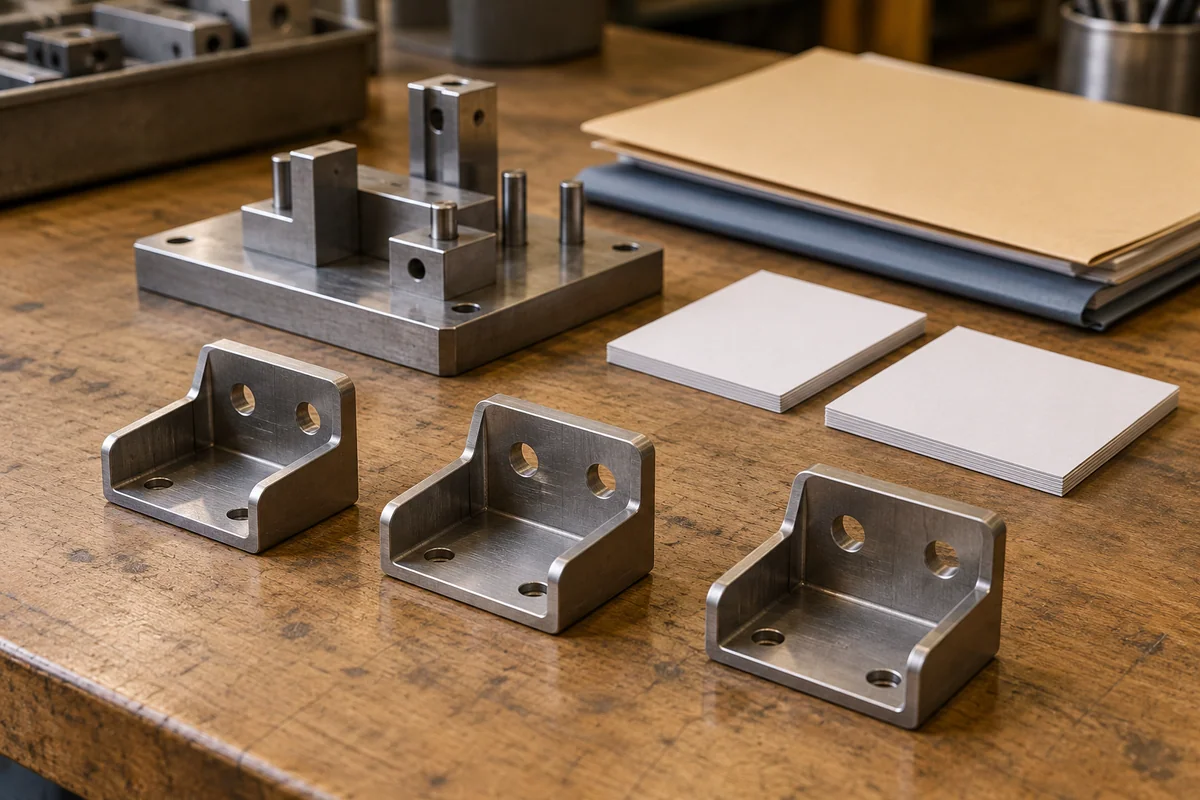
Ask a custom-part supplier to separate the piece price from every setup, development, sample and tooling charge. For each charge, identify the work or object it buys, the drawing revision it covers and the event that makes it payable. An unexplained “mold fee” is too vague to compare or carry into a repeat order.
This framework suits authorized custom passive parts such as non-safety-critical organizer brackets or empty housings. It is a procurement method, not manufacturing instruction, a market-price guide or legal advice about ownership. The main artifact is a one-time-charge schedule with repeat-order questions kept visible.
Find out what each charge actually buys
Ask the supplier to describe the deliverable behind its terminology. A design review may produce comments or a revised drawing. Programming may produce work used in the supplier’s process. A fixture charge may relate to a physical object retained at the supplier. Sample manufacture may produce parts for a defined review. These should be identified separately when their scope or approval conditions differ.
Do not insist that every supplier use the same accounting label. Require a description clear enough to distinguish the work. If several tasks are commercially bundled, ask for their inclusions and completion evidence even if the price remains one line.
Also question “non-recurring.” Does it mean once for this drawing, once per variant, once per order or once per production run? A setup charge can recur under the supplier’s quoted terms. State the unit and recurrence condition beside the amount rather than inferring them from NRE, meaning non-recurring engineering, in a heading.
Build the charge schedule
Use the same required quantity and authorized drawing revision for every candidate. Add a line when a variant requires separate work. Keep recurring production costs outside the one-time-work total.
| Charge or workstream | Deliverable and scope to request | Commercial question to resolve |
|---|---|---|
| Design or manufacturability work | Review record or agreed revised file; responsible approver | What changes are included and who authorizes them? |
| Programming or process preparation | Defined preparation work and completion evidence | Is it reusable, and what triggers another charge? |
| Physical tooling or fixture | Identified object, relevant drawing and intended production use | What is retained, supplied or available for later use? |
| Samples | Quantity, revision and purpose of the sample run | Are sample parts or later credits included? |
| Setup | Work required for the stated production run | Does it recur on every run, restart or variant? |
| Revision work | Specific approved change from the quoted baseline | Is a new quote required before work starts? |
| Storage or maintenance | Custody, preservation or maintenance scope if offered | What periods, triggers and charges are agreed? |
For each row, add the currency, amount, included items, payment milestone, completion evidence, quote validity and current status. Mark unresolved terms explicitly. A missing reuse answer should not become an assumed free service in the second-order budget.
Tie milestones to identifiable events. For example, a proposed payment may be due before work begins or after an agreed deliverable is reviewed. Record the actual proposed term and ask what happens if a review identifies a discrepancy. Do not invent a universal deposit percentage or a refund entitlement.
Keep tool custody and rights separate
Before relying on future reuse, ask where the physical item will be kept, how it is identified and who may authorize its use. Request the offered terms for maintenance, damage, inactivity, storage, disposal notice and retrieval. If transfer to another manufacturer matters, ask what physical items, files and information would be supplied and under what conditions.
Ownership, possession, permitted use and practical transfer are distinct questions to put into the agreement. Payment for a charge should not be used by the purchasing team as a substitute for explicit terms. Have the rights holder and an appropriate adviser review consequential ownership or intellectual-property provisions for the actual contract.
A public provider example shows why questions must be specific. Protolabs’ US injection-molding comparison page separates prototype and on-demand service options and states that ownership, maintenance and pricing vary by option; its table also states that setup fees apply to each run. That is an observation of one provider’s published service comparison, not a rule for China suppliers or a quote for the reader’s part. Protolabs service-option comparison
Do not copy that provider’s conditions into a different supplier’s order. Ask for the terms that actually govern the proposed work. Confirm that you are authorized to share the drawings and request manufacture before distributing the RFQ.
A hypothetical first order and conditional repeat
The following example uses entirely invented USD amounts, supplier names and terms. Assume 200 identical approved non-safety-critical brackets, the same drawing and acceptance scope, and no differences in usable quantity. Freight, taxes, payment fees, inspection beyond the assumed scope and all other unlisted costs are excluded.
Offer A contains a USD 120 fixture charge, USD 60 setup for the run and a USD 3.00 piece price. Its first-order product-and-setup subtotal is USD 120 + USD 60 + 200 × USD 3.00 = USD 780, or USD 3.90 per ordered bracket on this limited basis.
Offer B contains USD 30 setup and a USD 3.60 piece price, with no separate fixture charge under the example’s assumptions. Its corresponding subtotal is USD 30 + 200 × USD 3.60 = USD 750, or USD 3.75 per ordered bracket. B is USD 30 lower for this first order, despite its higher piece price.
For a separate repeat-order scenario, assume A’s fixture is available for reuse without another fixture charge, its setup charge recurs, and both suppliers hold the same piece prices for another 200 brackets. A becomes USD 60 + USD 600 = USD 660. B remains USD 750. A is USD 90 lower for that repeat. These are conditional calculations, not promised future prices or evidence that a second order will occur.
If A has not agreed the fixture’s reuse terms, leave its repeat scenario unconfirmed. Do not use the apparent future advantage to settle today’s decision. Avoid spreading the fixture charge over an invented lifetime volume merely to make the first purchase look less expensive.
State what happens when the part changes
Ask whether a changed drawing, material, finish or variant requires revised preparation or tooling. The supplier should explain the effect on its quoted work, while the authorized design owner decides whether to accept the proposed product change. Do not accept an easier-to-manufacture substitution solely because it avoids a charge.
Request written approval before additional paid work begins, with the affected charge lines and deliverables identified. Preserve the earlier quote and drawing so the change can be understood. A sample review and a tooling-payment milestone should each say what they approve; neither should silently authorize every later production change.
Hold when a substantial charge has no identifiable deliverable, the paid work’s revision is unclear, required drawing rights are unresolved or essential reuse and custody terms are missing. If no later order is planned, say so and evaluate the first order on its own merits.
Send the supplier the charge schedule with the drawing index and required quantity. The response should show exactly what is being priced now, which obligations continue later and which questions need agreement. Keep sourcing service fees, freight allocation and surplus-pack economics in their own comparisons.
Frequently asked questions
Does paying a tooling fee establish ownership?
Do not assume that from the charge alone. Request explicit ownership, custody, permitted-use and transfer terms, and have important rights reviewed by an appropriate adviser.
Is a setup fee necessarily non-recurring?
No universal treatment is assumed. Ask whether it applies once per design, per variant, per order or per production run, then use the stated basis in the comparison.
Should I spread tooling cost across future orders?
Show that only as a clearly conditional planning scenario with supported quantity and reuse assumptions. Keep the first-order cash requirement visible and do not invent future demand.
What if the supplier bundles development and tooling into one amount?
Ask for the included work, deliverables, revision basis, milestones and recurrence conditions even if the commercial price stays bundled. A usable scope matters more than the label.
Sources
Discuss a sourcing request related to this article.Separate Tooling and One-Time Charges in a Custom-Part RFQ