
Ask What Configuration an Enclosure Protection Claim Covers
Connect an enclosure IP claim to the exact model, supplied accessories, modifications and evidence before relying on it in a quotation.
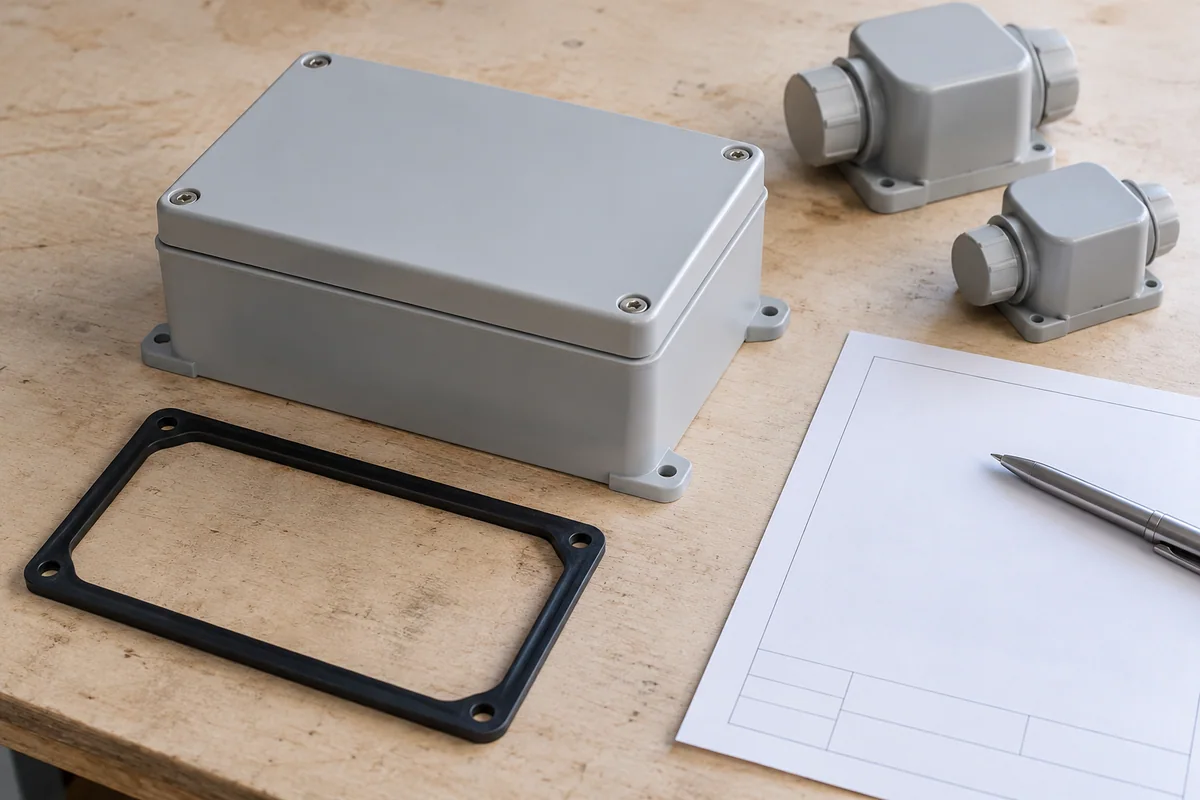
When an enclosure listing says “waterproof” or shows an IP designation, ask which exact configuration the evidence covers before relying on the claim in your RFQ. The quoted empty box, the configuration described in a report and the buyer’s intended finished arrangement may be different. Record those differences rather than treating a marketing word as an acceptance decision.
The useful deliverable is a claim-to-configuration evidence request. It connects the manufacturer’s model, the supplied lid and accessories, any specified modifications and the relevant evidence. It does not teach ingress testing or determine whether an enclosure is suitable for an electrical installation.
Establish what the supplier is claiming
Ask for the exact claimed designation, the referenced standard and edition, the manufacturer and the complete model or part number. Keep the original wording beside the supplier’s explanation. If the listing only says “waterproof,” leave the designation unconfirmed. Do not select an IP number on the supplier’s behalf.
IEC’s official public listing for IEC 60529 describes its scope as classification of protection provided by enclosures for electrical equipment with rated voltage up to 72.5 kV. That verifies the standard’s broad subject. The public listing alone does not establish the meaning or test conditions of a particular offered rating. This article does not reproduce or infer requirements from the paid standard. IEC 60529 public scope
Have the project owner define the intended conditions that need assessment. Give the reviewer an accurate description of location, exposure and use rather than a single word such as “outdoor.” Ask which evidence is needed for that application. Do not use the presence of an IP label to close separate environmental or electrical-safety questions.
Describe three configurations separately
First record the catalogue configuration: manufacturer, exact part number, body and lid version, supplied gasket and specified accessories. Second record what the supplier actually proposes to deliver, including added openings, substituted accessories or other custom work. Third record the intended project configuration if it differs from the supplied item.
For an empty enclosure, the third description may still be incomplete. That is an important fact to disclose. The enclosure buyer should not claim approval of a later populated assembly that has not been specified or reviewed.
Mark every difference between these records. Ask the manufacturer or competent reviewer whether the available evidence applies and what further information is needed. Do not assert that every change automatically cancels a rating, and do not assert that a small-looking change preserves it. Both conclusions need evidence appropriate to the specific configuration.
Use a claim-to-configuration request
Send the following register with the RFQ. Require an answer or a clearly marked gap in every applicable row.
| Record | Supplier response requested | What the buyer should keep open |
|---|---|---|
| Product identity | Manufacturer, full part number, body and lid versions | Any mismatch between listing, drawing and quote |
| Claim | Exact designation, standard and edition as claimed | An undefined marketing description |
| Supporting document | Issuer, report or declaration reference, date and relevant pages | Evidence not supplied or authenticity not checked |
| Covered configuration | Identified sample or product configuration and stated conditions | Missing connection to the proposed supply |
| Gasket and accessories | Exact references and whether supplied, substituted or omitted | Unexplained departures from the documented configuration |
| Openings and custom work | Controlled drawing or modification schedule | Applicability of evidence to each change |
| Intended arrangement | Buyer-approved application and configuration description | Later changes or conditions not yet assessed |
| Review decision | Reviewer, scope, date, conclusion and remaining conditions | No competent owner or an unresolved conclusion |
Keep document authenticity and configuration applicability as separate statuses. Obtaining a genuine document does not answer whether it covers the quoted arrangement. Equally, a missing report does not by itself establish that the product is defective. It means the claim-dependent decision remains unresolved.
A bounded manufacturer-document example
Hammond’s official page for part 1554P2GYCL identifies a polycarbonate enclosure with a clear lid, displays an IP68 attribute, and lists replacement gasket 1554NGASKET among its accessories. This is a concrete example of the identifiers to preserve in an RFQ. It is an observation of the manufacturer’s published claims, not an independent verification of test results. Hammond 1554P2GYCL product record
The page reviewed does not establish coverage for a buyer’s proposed new openings or substituted fittings. Nor does it supply an approval for an unrelated seller’s visually similar enclosure. To assess an actual modified offer, request the exact drawing and the evidence or manufacturer clarification connecting that version to the claim. No purchase recommendation, affiliation or stock availability is implied by this example.
Handle a hypothetical modified offer
Assume a fictional seller quotes enclosure E-14 with two added openings under drawing D-14 revision B. Its listing says “waterproof.” The seller sends a document that identifies E-14, but the provided pages do not describe the added openings or the accessory configuration. These identifiers and documents are invented for the example.
Enter the response as “claim evidence incomplete for quoted configuration.” Ask the seller to identify the claimed designation and supply the configuration evidence, relevant conditions and a complete accessory list. Give the question to the designated reviewer. Do not change the status to “unsafe,” “certified” or “passed” from this gap alone.
If the seller offers the catalogue enclosure without the openings instead, retain it as a separate proposal. It may not meet the buyer’s original scope. The buyer should neither accept a different item silently nor plan unreviewed modification after delivery to make the quotation work.
Keep the quotation conditional until the gap is resolved
Request a written distinction between the product price, proposed custom work and any additional evidence or review work being offered. Ask who provides each deliverable and when. A statement that evidence will follow later should have an owner and a decision point; it should not be recorded as evidence already received.
Hold claim-dependent selection when the exact model is unidentified, a report cannot be connected to the configuration, proposed changes are unexplained or the intended conditions are still unknown. Ask the responsible specialist whether the appropriate next step is clarification, different evidence, a revised proposal or another enclosure candidate.
Do not conduct improvised hose, immersion or energized demonstrations to close the paperwork gap. This RFQ method is for requesting and reviewing evidence. Any necessary testing requires a competent provider and an agreed scope.
Before accepting the quote, save the final model and configuration schedule, document references, specialist review outcome and all remaining conditions together. Require a fresh review if the quoted configuration changes. The objective is a traceable statement of what has been supported for this purchase, with uncertainties still visible.
Frequently asked questions
Can I translate “waterproof” into an IP rating?
No rating is established by that word alone. Ask the supplier for its precise designation, referenced standard and supporting configuration evidence.
Does an IP claim automatically cover added openings?
Do not assume either continued coverage or automatic loss. Ask the manufacturer or competent reviewer to assess the exact modification and the available evidence.
Is a genuine report enough to approve the enclosure?
Authenticity and applicability are different questions. The report must be connected to the quoted configuration and its conditions, then reviewed against the intended application.
Should missing evidence be recorded as a failed test?
No. Record the missing evidence and hold the claim-dependent decision. Do not invent a test result or a safety conclusion.
Sources
Discuss a sourcing request related to this article.Ask What Configuration an Enclosure Protection Claim Covers