
Keep an Empty Enclosure’s Lid and Hardware Associated in the Pack
Assign each empty enclosure body, detached lid and approved hardware pouch to a linked packing position without assuming interchangeable parts.
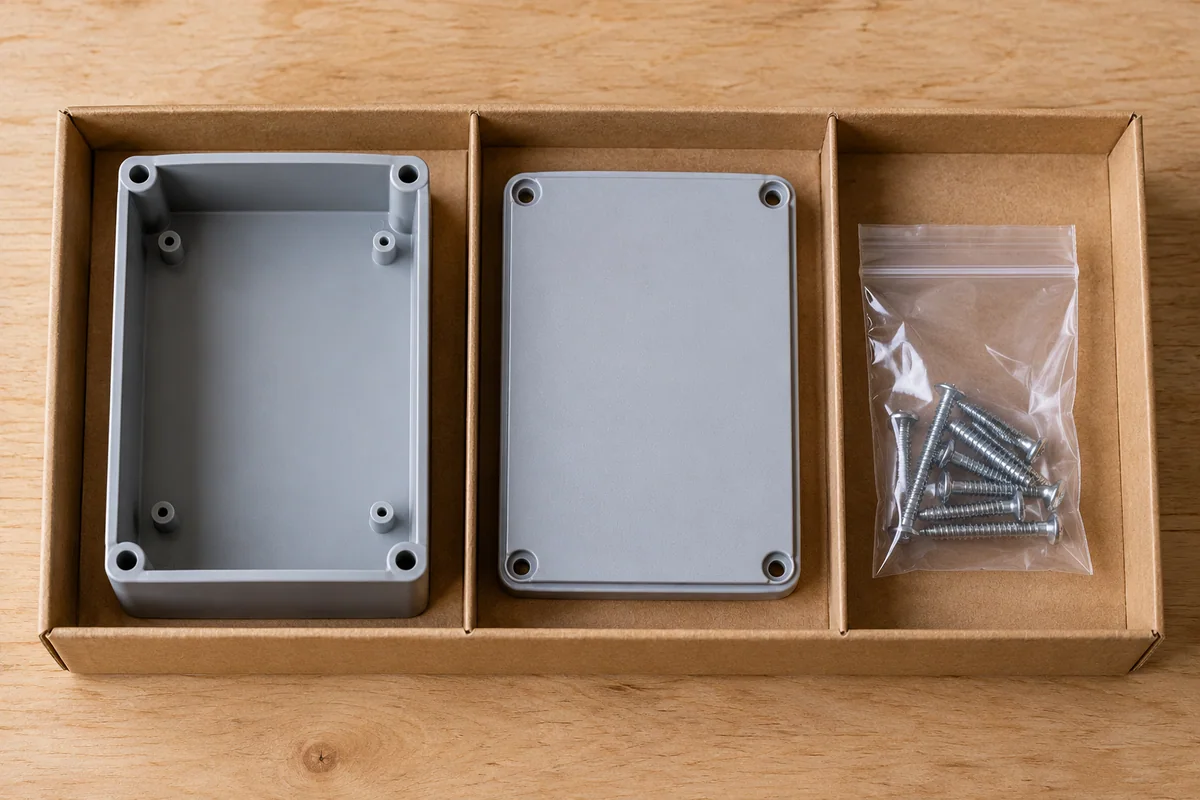
Give an empty enclosure, its detached lid and its approved hardware pouch one clear association in the packing plan. They may occupy separate compartments, but the packer and recipient should be able to identify which pieces belong together without guessing from size or color. An association map turns that relationship into an explicit packaging instruction.
Start with the buyer’s already approved contents and part relationships. This article does not select enclosure hardware, establish fit or determine a protection rating. No real order, drawing or packing layout is supplied; the examples concern empty passive cases and contain no batteries or electrical components.
Preserve the approved relationship
Copy the authorized body reference, lid reference and hardware-set reference into the map. Include the revisions or configuration identifiers that the buyer’s product records use. If the product owner requires unit-specific pairing, retain that requirement instead of reducing it to a model-level match.
Distinguish those two situations. A model-level relationship may allow the approved lid reference to accompany any body within an expressly authorized configuration. A unit-specific relationship requires the identified pieces to stay together. The packing team should not choose between those interpretations because several parts look alike.
A public manufacturer’s catalog illustrates why the distinction matters. Hammond’s 1591 series page describes different lid-fastener arrangements for its standard and economy versions. This is a bounded example of variation within a named enclosure series, not guidance to select or substitute screws for another case. Hammond 1591 series information
If the approved relationship is missing, return that question to the product owner. Packaging cannot resolve it through a trial fit or by combining whatever hardware is available. Keep product engineering and the packing association as separate decisions.
Choose a location for every associated piece
Mark a reserved position for the body, lid and pouch on the proposed layout. Describe positions from one consistent viewing direction so “left pocket” does not change when someone rotates the tray. Use layout references rather than relying solely on the names of colors.
For the lid, show which face is oriented toward the compartment and where any required separator sits. For the hardware pouch, show the proposed retention and its permitted contact relationships. Placing the pouch inside the cavity is one possible proposal only when expressly allowed by the product and packaging owners; an empty cavity does not make loose contents acceptable automatically.
Do not instruct the packer to scatter loose fasteners around the body. Request a defined containment and location proposal for the approved hardware set. Its suitability, material and contact restrictions still need the applicable review. A sealed pouch’s appearance alone does not prove that it will remain where intended.
Make the association map usable
Use one row for each approved body–lid–hardware combination. Keep the contents references and physical positions together so a reader can follow the relationship without opening several conflicting messages.
| Map field | What to specify | Ambiguity it prevents |
|---|---|---|
| Kit configuration | Approved kit ID and revision | Combining different versions in one unspecified plan |
| Body | Authorized part reference and reserved position | Matching only by apparent size |
| Lid | Authorized part reference, pairing basis and reserved position | Assuming every lid in a series is interchangeable |
| Hardware set | Approved set reference and contents source | Choosing substitute pieces at packing time |
| Pouch and location | Approved pouch reference, assigned position and retention proposal | Leaving loose hardware in an undefined cavity |
| Association cue | Approved identifier or physical grouping method | Losing the relationship when pieces occupy separate compartments |
| Contact restrictions | Protected faces and applicable separator references | Solving association while overlooking surface contact |
| Exception owner | Who decides on a missing, ambiguous or changed reference | Informal substitutions becoming the new baseline |
An association cue might be an approved pack-position identifier or a paired sleeve-and-pocket arrangement. Do not invent product labels or cover existing information to implement it. If an identifier must be added physically, have the buyer approve its content and placement through the applicable artwork process.
Plan the moment of separation
A layout that looks clear while the tray is full may become ambiguous after the first item is removed. Walk through the proposed unpacking sequence with the packaging owner. Ask whether the lid remains associated with the body after its sleeve leaves the tray, and whether the hardware pouch can still be identified when several kits are open together.
The answer need not involve elaborate labeling. One complete kit per defined inner grouping may be enough if the buyer’s approved contents and layout support it. Where a shared compartment holds lids for several bodies, require an explicit association method and recipient sequence instead of assuming the recipient will reconstruct the pairing.
Review any grouped or bulk alternative against the intended handover. A workshop opening many units at once may have a different association need from an individual recipient opening one sellable kit. That choice belongs in the buyer’s pack configuration, without inventing a universal rule for every customer.
A hypothetical two-configuration decision
Suppose fictional passive case configuration A uses body B-A, lid L-A and hardware set H-A. Configuration B uses B-B, L-B and H-B. Their lids look similar. The buyer’s approved records keep the combinations distinct and do not authorize interchangeability.
The proposed pack gives each body position P1, each sleeved lid P2 and each contained hardware set P3 within its own kit tray. The association map ties those positions to configuration A or B. The positions describe a proposed layout; their protective adequacy has not been assessed.
A second proposal places all lids in one common sleeve and all hardware pouches in an unassigned cavity. Even if the planned totals are correct, this proposal has lost the intended relationship. The buyer should request a revised association method or retain separate kit groupings. More counting would not answer the design question.
If a pouch marked H-B is offered for configuration A, the packing map should identify the unresolved reference and owner. It should not become an instruction to test whether the parts fit or to substitute them. Any approved change must update the product relationship before the pack map is revised.
Handover with a clear exception rule
The final map should identify the approved combinations, positions, separators and association cues, plus the exact layout revision. Ask the packer to acknowledge any position it cannot implement before production packing is authorized. This is a request for confirmation of the proposed work, not a claim that a particular service is available.
When an association is unclear, keep that kit configuration pending and ask the named owner for a specific answer. Avoid declaring an entire batch acceptable because the right number of lids and pouches appears in a list. The packaging outcome is narrower and more useful: each approved body can remain connected to its designated lid and hardware through the intended handover.
Frequently asked questions
Must the lid be attached to the body during packing?
Follow the approved product and packaging configuration. A detached lid can have a reserved compartment or sleeve, provided its association and permitted contacts are explicitly addressed.
Can the hardware pouch go inside the empty enclosure?
Only when the responsible owners approve that location, containment, retention and contact relationships. This article does not approve loose hardware or any arrangement involving batteries or electrical parts.
Are correct totals enough to approve a shared lid compartment?
No. Planned quantities do not establish which lid and hardware set belong to which body. The shared arrangement still needs an approved association method.
Does a packing association confirm mechanical fit or an IP rating?
No. The map preserves an already approved relationship. Product fit, fastening requirements and any protection claim require their own applicable evidence.
Sources
Discuss a sourcing request related to this article.Keep an Empty Enclosure’s Lid and Hardware Associated in the Pack