
Make the Sample RFQ State What the Production Quote Must Match
Use a sample-to-production crosswalk to record limited approvals, temporary exceptions and the requirements a later production quote must answer.
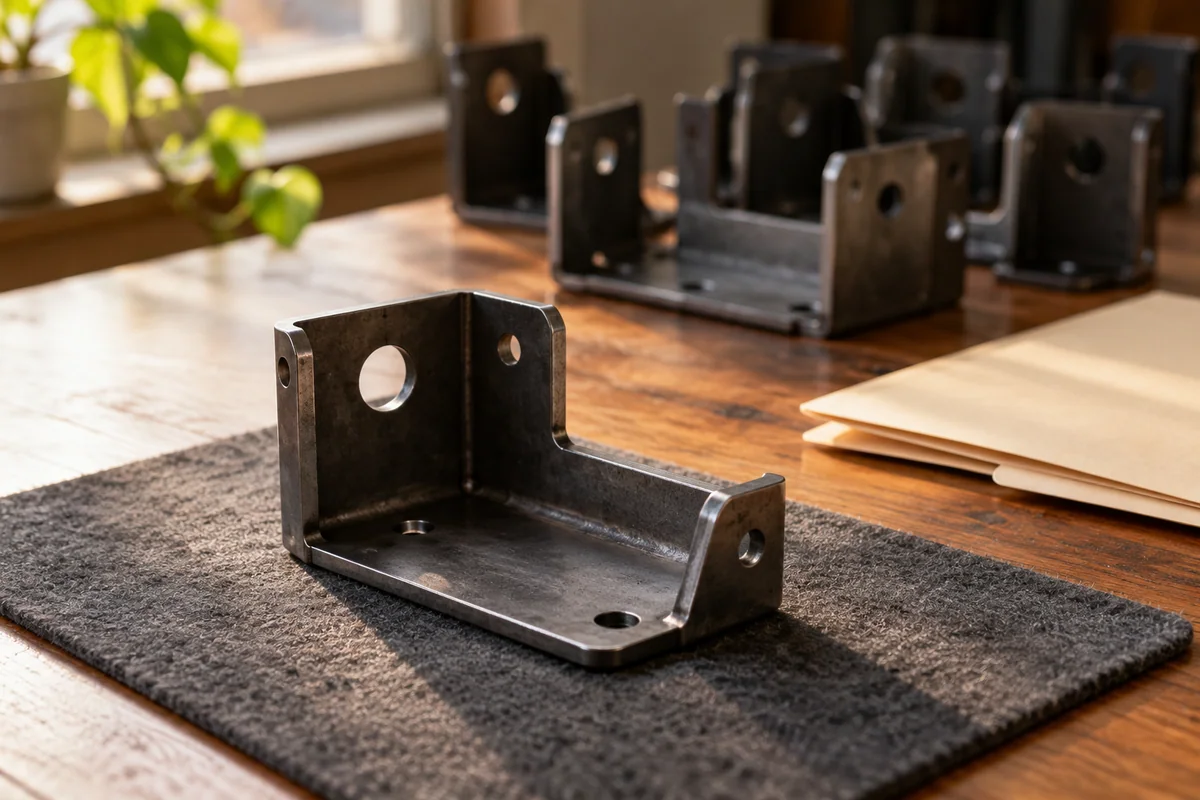
Before ordering a sample, state what it is meant to answer and which parts of the planned production specification it represents. Otherwise, “sample approved” can become a broad statement that neither buyer nor supplier intended. A fit check of one unfinished bracket is not approval of an unexamined finish or a later production batch.
Use the sample RFQ to build a requirement-by-requirement bridge to the production quote. Record the requested feature, the version supplied for the sample, any temporary exception, what was actually reviewed, and the response required before the production offer can rely on it. This is a quote-baseline method, not a statistical sampling or receiving-inspection plan.
Give the sample a specific job
Write the purchasing question before writing the sample quantity. You may need to examine an appearance reference, check a documented interface, or resolve whether the supplier understood an approved drawing. Keep those purposes separate. A sample intended to settle one question should not silently settle every other requirement.
Name the sample reference and the approved drawing or specification issue it is supposed to represent. Ask who will supply it and what relationship it has to the proposed production version. The supplier should identify known differences in material, finish, geometry, accessories or process rather than simply saying that it is representative.
If the proposed production process has not been chosen, record that fact. A sample from existing stock may still answer a limited question, but its source does not establish which process, site or configuration a later order will use. Only an order-specific supplier response can clarify that connection, and any technical implications require appropriate review.
Separate required attributes from temporary exceptions
A temporary exception needs a name and a closing condition. “Sample finish differs; final finish later” is weaker than “sample S-03 is supplied unfinished for the stated geometry review; production must quote finish requirement F-02; evidence and appearance approval remain open.” Both parties can understand what the second statement leaves undecided.
Do not delete an exception once the sample arrives. Carry it into the production RFQ until the supplier answers the corresponding production requirement and the authorized owner accepts the resolution. Keep a changed requirement distinct from an exception: if the buyer decides the original finish is unnecessary, that is an approved baseline change, not proof that the unfinished sample met the old brief.
Also record unperformed checks. “Not reviewed” is a valid outcome. It avoids a future reader interpreting the absence of a comment as acceptance. Required functional, safety or compliance questions should remain with qualified reviewers; a purchasing team should not improvise testing to turn an incomplete sample into a complete approval.
Use a sample-to-production crosswalk
The table below is a reusable template. Complete it while requesting the sample, update it after the limited review, then send the same references with the production RFQ.
| Crosswalk field | What belongs in it | Production-quote question |
|---|---|---|
| Requirement reference | Drawing feature, material note, finish or accessory ID | Which issue are you pricing? |
| Required production state | Exact authorized requirement | Is this included without deviation? |
| Sample identity and state | Sample ID and documented version supplied | Does the sample represent this attribute? |
| Known exception | Exact difference and reason supplied | How will the difference be closed? |
| Evidence actually reviewed | Record, document or defined observation | Which unreviewed evidence remains due? |
| Limited disposition | Accepted for stated purpose, rejected or not reviewed | What may the quote legitimately rely on? |
| Next decision | Owner, required input and decision point | Is the offer conditional on that decision? |
Make references specific enough that someone else can find the evidence. “Photo sent Tuesday” is fragile. A dated image set tied to S-03 is easier to match to a particular sample. If more than one sample exists, record which one was reviewed and avoid borrowing an appearance result from one unit and a geometry result from another without saying so.
A hypothetical fit-only bracket review
Imagine a fictional passive organizer bracket, not a safety-critical or powered assembly. The intended production brief is drawing BR-24 Revision C plus finish requirement F-02. The supplier offers sample S-03 with the specified geometry but a temporary unfinished surface. No actual product, measurement, supplier capability or production outcome is claimed here.
The buyer’s agreed purpose is a limited interface review against an authorized reference. After that review, the record says: “S-03 accepted for the stated interface review only. Finish F-02 not represented. Material evidence not reviewed. Production-quote acceptance remains pending.” This is more useful than a general “looks good.”
The production RFQ then asks the supplier to quote Revision C with F-02, identify the proposed production version, state any remaining differences from S-03, and identify the evidence or additional representative sample required to close the open fields. The supplier may confirm the requirement, propose an alternative, or say the offer is conditional. None of those answers should be invented by the buyer.
If a later sample S-04 carries the production finish, give it a separate record. Do not assume that reviewing its appearance automatically repeats or supersedes every earlier check. Ask the responsible owner which prior conclusions remain applicable and which questions need another review.
Make the production reply restate the baseline
Request an explicit production response for every material crosswalk row. The reply should name the drawing issue, material requirement, finish, included accessories and any applicable sample references. It should say which exceptions are closed, which remain conditional and which new changes are proposed.
Ask the supplier to confirm the quoted production quantity, the version being supplied and the basis of any lead-time statement. A sample quote alone does not establish production pricing, availability or timing. Keep those commercial confirmations distinct from the sample review so neither is used as a substitute for the other.
Avoid a sentence such as “same as approved sample” when the sample had exceptions. State the sample attributes incorporated into the baseline and list the additional production requirements. If a physical reference is retained, record its identity, custody and permitted use; an unidentified object on a shelf is a weak purchasing reference.
Set clear conditions for a new decision
Require clarification before relying on the production quote if the supplier changes the material, drawing, finish, source or process represented in its earlier response. This is a request to identify what changed, not an assertion that every change has the same technical consequence. The authorized owner decides what further evidence is needed.
Hold the production comparison when the sample cannot be identified, an exception has no closing condition, the supplier will not describe the production version, or someone treats an unperformed review as passed. If the deadline cannot accommodate necessary clarification, compare another properly defined option rather than broadening the sample approval by assumption.
The output of this method is a bounded production-quote baseline: what the sample showed, what remains to be supplied, and who must decide. It does not promise that future units will be identical. Later production verification and receiving acceptance remain separate work to agree before the order proceeds.
Frequently asked questions
Does sample approval mean the production batch is approved?
No. Record which sample attributes were reviewed and the limits of that decision. Production verification and acceptance need their own agreed scope.
Can I accept a sample with a temporary finish?
You can make a limited decision for an authorized purpose if the exception is explicit. Keep the actual production finish and the evidence needed to approve it open in the crosswalk.
What should “same as sample” include?
Identify the exact sample and the specific attributes incorporated into the production requirement. List temporary exceptions and additional production requirements rather than relying on the phrase alone.
What if the supplier changes its production process?
Ask for a documented description of the change and a refreshed production response. Have the authorized technical owner determine what evidence or renewed review is needed.
Sources
Discuss a sourcing request related to this article.Make the Sample RFQ State What the Production Quote Must Match