
Keep Material Grade and Finish Separate in DIY Part Quotes
Separate material designation, condition, finish process and appearance evidence before treating DIY-part supplier offers as equivalent.
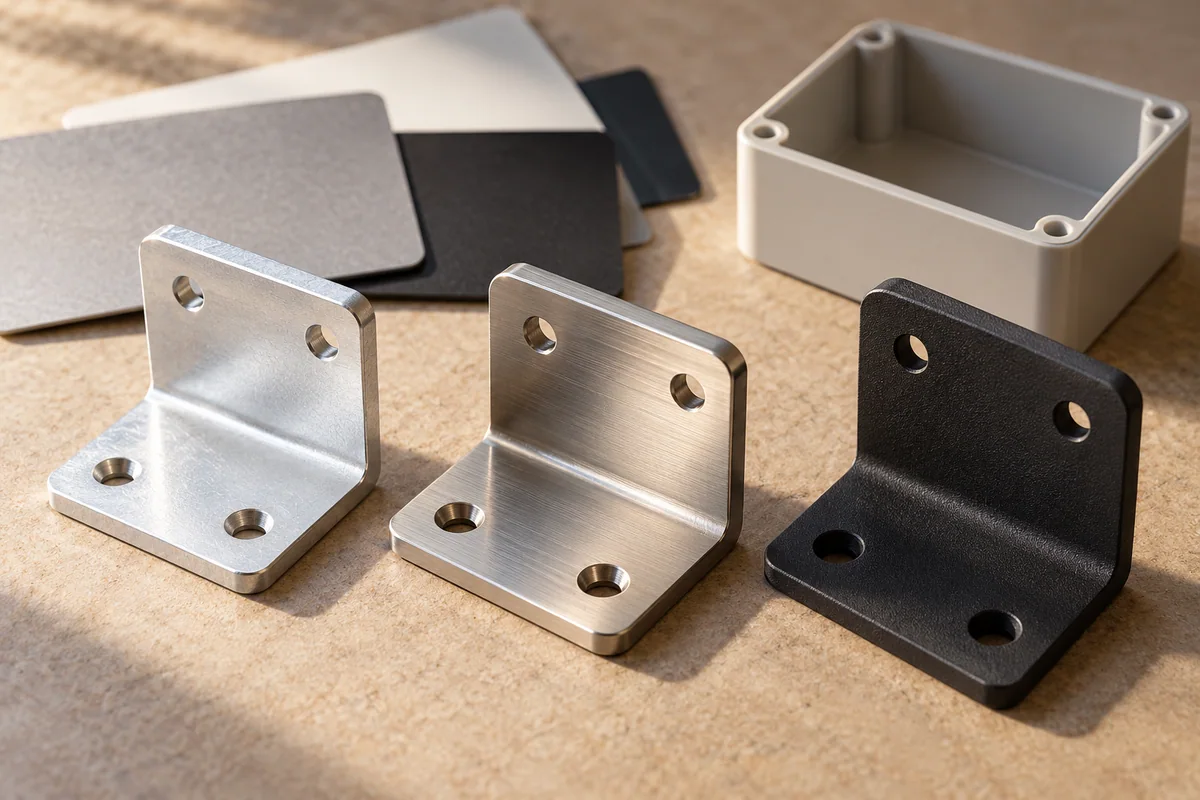
“Black metal bracket” does not identify a material or a finish process. One offer may name an alloy but leave the surface treatment open. Another may promise the right color without identifying the underlying material. Similar photographs cannot close those gaps.
For a DIY part RFQ, compare material identity and finish requirements in separate fields, then connect each field to the evidence required for that decision. The aim is to establish whether the offers answer the same approved brief. It is not to choose an alloy from a photograph or turn a cosmetic sample into proof of performance.
Start with the requirement owner
Ask who selected the material and why it is required. If a responsible designer supplied a designation, preserve the complete designation, condition or temper where specified, product form and applicable standard reference. Do not shorten the requirement to a familiar grade number if doing so removes information.
If the buyer has only a use case, write the unresolved requirement as a question for an appropriate designer. A purchasing agent can collect options and documents, but should not quietly decide which material is adequate for a load-bearing, electrical, thermal or other safety-relevant purpose. Keep this purchasing method separate from engineering selection.
Define substitution authority at the same time. The useful instruction is “quote the stated material; identify any proposed alternative and its supporting evidence.” A broad phrase such as “equivalent accepted” leaves unanswered who may determine equivalence and which properties matter.
Use one public example to see what a grade name omits
Hydro’s official Alloy 6061 datasheet, revision 2019/01, lists multiple standard and special temper designations. Its property table is specifically identified as extruded-product data. That is a concrete reason to retain the full supplier designation and product form rather than recording only “6061.” It does not establish that any seller’s bracket was made from Hydro material. Hydro Alloy 6061 datasheet
The public scope of ASTM B221-21 concerns aluminum and aluminum-alloy extruded bars, rods, wire, profiles and tubes. It refers alloy and temper designations to ANSI H35.1/H35.1M. That scope check helps identify the kind of source being discussed; it is not a finding that a finished part complies with the standard. No paid tables, mechanical limits or equivalence rules are inferred here. ASTM B221-21 public scope
Together, these sources support a documentation lesson: alloy, condition and product form are distinct information. They do not authorize substituting one temper for another, prove a coating requirement, or select material for a particular bracket. An actual offer still needs its own applicable documents and design review.
Give finish its own specification
Ask whether the finish requirement concerns appearance, a specified process, a functional property, or several of those things. Keep each requirement explicit. Color, gloss and texture belong in appearance fields. A process name belongs in a separate field. A required performance characteristic needs its own agreed criterion and evidence.
Do not add an invented coating thickness, corrosion duration or test threshold merely to make the RFQ look technical. Have the responsible owner define the requirement, applicable method and acceptance basis. If the drawing already specifies a finish document and revision, cite that controlled reference rather than paraphrasing it as “durable black.”
Where appearance is important, identify the approved reference sample or artwork/color specification and the scope of any review. A photograph may communicate an appearance target, but do not record it as material-composition or coating-performance evidence. If the supplier proposes a different process that looks similar, keep it as a proposed alternative.
Build a material-and-finish comparison sheet
Use one row for each requirement rather than one cell containing a paragraph of supplier promises. The sheet below is a reusable buyer artifact. Fill the evidence column with an identifiable document, sample record or an explicit “not supplied.”
| Requirement field | Buyer baseline | Supplier response to capture | Decision or evidence gap |
|---|---|---|---|
| Material identity | Full authorized designation | Exact offered designation, without abbreviation | Missing or different designation |
| Material condition and form | Stated temper/condition and product form, where required | Exact offered condition and source form | Assumed equivalence needs design review |
| Source specification | Issuer, identifier and edition if specified | Claimed applicable specification | Scope or edition mismatch |
| Finish process | Controlled process requirement or unresolved question | Named proposed process and exclusions | Appearance answer only |
| Appearance | Approved reference and review scope | Matching reference or proposed variation | Reference not identified |
| Functional finish requirement | Authorized criterion and evidence required | Offered evidence and limitations | Performance unsupported |
| Traceability and evidence | Required connection to offered goods | Document reference and how it relates to the quote | Generic catalogue only |
| Deviation decision | Named approval owner | Proposed change, reason and affected quote | No authorized disposition |
Distinguish evidence that exists now from evidence promised with production. If the quote includes a document to be supplied later, record its deliverable, timing and the decision that remains conditional. A promised report should not appear as an already-reviewed result.
A fictional pair of incomplete offers
Suppose a buyer has an authorized material requirement M-04 and finish requirement F-02 for a passive organizer bracket. These are invented project references, not real material grades or industry standards. The example contains no actual supplier quote or tested product.
Offer A explicitly accepts M-04 but says nothing about F-02. Offer B accepts F-02 but describes the base material only as “metal.” The two omissions are different. Neither offer is ready for a matching product-price comparison, even if both suppliers send attractive black-bracket photographs.
Ask A whether its price includes F-02 and the required evidence. Ask B to identify the material it priced and confirm whether it meets M-04, with any substitution stated separately. Keep the original replies beside the clarifications. If B later proposes material M-05, do not replace M-04 in the baseline column; record a deviation awaiting the authorized owner’s decision.
No price adjustment is estimated in this example. Missing information could lead to confirmation, a revised quote or a rejected alternative. Only the suppliers’ actual replies and the buyer’s approval can resolve that outcome.
Decide what can proceed and what must wait
An offer can be ready for commercial comparison when the relevant material and finish fields are explicit and the required evidence stage is agreed. That is narrower than declaring the goods qualified or the batch acceptable. Record exactly which decision has been made.
Hold a material-dependent decision when the designation is missing, documents concern another form or condition, the supplier claims equivalence without the needed review, or the finish response answers only color while a process or performance requirement remains open. Do not disguise an unresolved requirement as a small purchasing preference.
Finish the RFQ round with a compact request: return the sheet with exact material and finish answers, cite supporting documents, identify exclusions, and put alternatives in the deviations column. That gives the buyer a meaningful comparison without claiming that appearance proves what a part is made from.
Frequently asked questions
Can matching color establish matching material?
No. Record the material designation and its supporting evidence separately from appearance. A similar-looking surface leaves composition and functional requirements unresolved.
Is a grade number alone enough?
It may omit required condition, temper, product form or specification details. Preserve the complete authorized requirement and ask the supplier to identify exactly what it priced.
Who decides whether an alternative material is equivalent?
The person authorized and competent to approve the application requirement. The supplier should describe the alternative and supply relevant evidence; a purchasing comparison does not establish equivalence.
Should every quote include the same certificate?
Ask for evidence appropriate to the actual requirement and its connection to the offered goods. A generic document or an unrelated certificate should not be treated as a universal material approval.
Sources
- Existing sourcingagent guides, supplied full-content snapshotSourcingagent repository; supplied authoring snapshot
- Alloy 6061, Revision 2019/01 (2/2019)Hydro Extrusion North America
- ASTM B221-21 public title and scopeASTM International
- Existing public English RFQ worksheet, supplied snapshotSourcingagent repository; supplied authoring snapshot
Discuss a sourcing request related to this article.Keep Material Grade and Finish Separate in DIY Part Quotes