
Energy-Storage Delivery Costs: Check Access Before Ordering
Define site access, unloading, handover, and onward placement before buying an energy-storage unit so your delivery budget covers the required work.
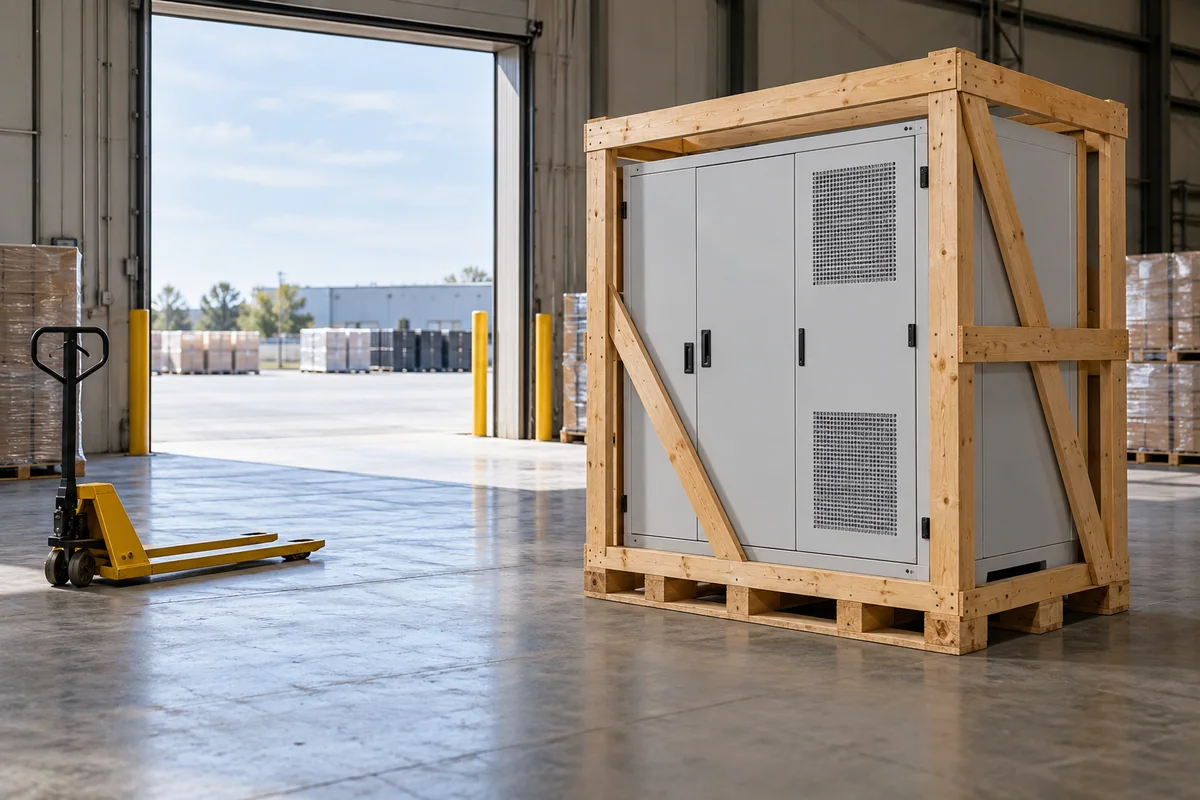
A quote that reaches your postcode may still stop short of the place where an energy-storage unit needs to go. The truck’s arrival, unloading from the vehicle, movement across the site, and placement for installation are separate tasks. Before ordering, identify the exact handover point and obtain a workable plan for every step after it.
This is a buying and logistics exercise. Ask qualified transport, lifting, and installation professionals to assess the equipment and site. A checklist of gate widths and package weights cannot certify that a heavy battery unit can be moved safely.
Draw the final delivery journey in four stages
Start with four plain descriptions: where the vehicle may stop, how the packed unit leaves the vehicle, where it can safely be received, and who moves it to its intended location. Use actual places, such as the warehouse loading bay or a designated external receiving area, rather than “door delivery.”
For each stage, name the service provider, the responsible site contact, required equipment or access arrangements, and the party paying. Record unresolved items as unknown. If the supplier says delivery is included, ask it to confirm which stages that sentence covers.
This prevents an expensive mismatch: the transport provider pricing a curbside handover while the buyer assumes placement inside a plant room. Even where the final unit is compact, its transport crate or pallet may define what the delivery service has to handle. Ask about the packed shipment, not only the product’s catalogue dimensions.
Prepare a site brief before asking for a final price
Request the supplier’s packed dimensions, gross weight, number of handling units, handling documentation, and any stated restrictions. Supply those documents to the provider without improvising an unloading method yourself. If the final packing has not been designed, label the dimensions as provisional and make the delivery budget conditional.
The destination brief should include:
- Complete address, postcode, named receiving contact, and permitted delivery hours
- Commercial, residential, construction, or other site context described accurately
- Vehicle approach restrictions, turning constraints, gate clearances, and booking requirements
- Loading-bay or ground-level receiving arrangements
- Relevant surface, slope, stairs, thresholds, and distance beyond the unloading point
- Available site handling equipment and the responsible qualified operator
- Where the packed goods may wait if installation is not immediately possible
Ask the receiving team to verify these facts. A satellite image or a photograph of an open gate may help explain the site, but neither confirms load capacity, safe vehicle access, or a lifting plan. Give the contractor enough evidence to decide whether a site survey is needed.
Treat liftgate service as a defined movement
A liftgate raises or lowers freight between ground and vehicle level. FedEx’s freight guidance notes that failing to arrange one when needed can delay collection or delivery and cause extra charges. That is a carrier-specific explanation of an access problem, not a promise that any liftgate can handle your energy-storage shipment. FedEx freight access guidance
Ask the provider to assess suitability against the actual packed unit and its handling requirements. Do not infer capacity or fit from the word “liftgate” on a quote. A unit that needs a different unloading arrangement should be priced for that arrangement before the order is placed.
Also ask what happens after ground-level unloading. Moving a pallet across a site, passing a doorway, negotiating stairs, and positioning equipment may fall outside the delivery service. If a specialist placement contractor is required, coordinate its attendance and scope with the transport provider. Do not plan to solve a rejected unloading arrangement with untrained helpers on arrival day.
Separate included costs from event-triggered costs
Request an itemized final-mile offer. Ask whether it includes the appointment, necessary vehicle type, agreed unloading service, movement beyond the unloading point, and waiting time. Where relevant, ask about additional charges for a failed attempt, changed address, restricted access, storage, or rescheduling.
For each conditional charge, request the triggering event, calculation basis, payer, and any notice or authorization process. Avoid inventing a contingency percentage and calling the result an all-in delivery price. A budget allowance can be useful, but an allowance does not settle who owes an actual charge.
Compare alternatives at the same endpoint. Delivery to a depot plus a separately hired placement contractor can be a different service from direct site delivery. Neither is automatically cheaper or better. Include the extra collection, coordination, temporary storage, and handling steps in the comparison, then have the relevant specialists assess feasibility.
A hypothetical comparison of two delivery scopes
Assume Offer A is USD 300 to an accessible receiving point, with no onward placement. A separate qualified contractor hypothetically quotes USD 220 for the agreed onward movement. Offer B is USD 470 for both stages, subject to written confirmation of the same site conditions. These invented figures illustrate scope comparison only; they are not market prices. Duties, taxes, installation, insurance, waiting and exceptional access work are excluded.
On those assumptions, A’s combined quoted scope costs USD 520 and B’s costs USD 470. The USD 50 difference is meaningful only if both cover the same work and responsibilities. If B excludes a necessary unloading service, or if its site assumptions are wrong, the comparison is incomplete.
The decision should also consider the handover between contractors. Ask who controls the schedule, who confirms the goods are ready for the second stage, and who bears any agreed waiting charge. A lower combined number can still leave a coordination gap that matters to the project.
Confirm the receiving plan before release
Before collection, reconfirm the final packing data, destination access, appointment, responsible people, and agreed handling service. Make sure the receiving team has the order and packing references needed to identify the delivery and record visible condition or shortages through the provider’s procedure.
If damage or an unsafe condition is suspected, do not energize, open, or attempt to repair the unit to find out whether it works. Obtain appropriate supplier and qualified safety/logistics guidance. Delivery completion and installation readiness are separate decisions.
For a sourcing request, send the supplier model and packed shipment details together with the site brief. Ask for a quotation to a precisely named handover point, and resolve unloading and onward placement before treating the purchase budget as complete.
Frequently asked questions
Does “door delivery” include unloading?
Do not assume so. Ask for the exact handover point and a written description of unloading, inside movement, and placement services, including who supplies equipment and operators.
Can I book a liftgate before receiving final weights?
You can ask for a provisional plan, but have the provider assess the final packed weight, dimensions and handling requirements before relying on that service.
What if my site has no suitable receiving area?
Ask the qualified provider to assess alternatives, such as an appropriate receiving facility and a separately planned site movement. Price the whole sequence before selecting it.
Should delivery and installation be quoted together?
They may be coordinated or contracted separately. In either case, define the boundary so unloading, temporary storage, placement and installation are each assigned to an appropriate party.
Sources
Discuss a sourcing request related to this article.Energy-Storage Delivery Costs: Check Access Before Ordering